
This article was published in Scientific American’s former blog network and reflects the views of the author, not necessarily those of Scientific American
Every species alive today has a fossil record. That feels somewhat strange to say. We often make a clean division between the living and the petrified dead (the arbitrary marker being 10,000 years prior to our modern age). But it’s true. Even though the record is certainly not complete, and we have much yet to discover, you can still start at any of life’s extant twigs and draw it back to some ancient anchorpoint that helps fill in where that beautiful form came from. And the record isn’t just written in bone. Footprints can perform the same feat.
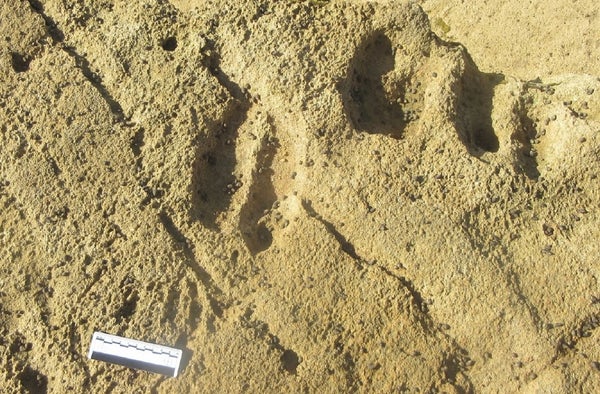
Over the course of a nine-year survey along South Africa’s Cape coast, paleontologist Charles Helm and colleagues found more than a hundred fossil tracksites. Embedded in the record of Pleistocene sand dunes were the footfalls of creatures that roamed the area over 100,000 years ago, including beasts familiar to us today. At one site east of Still Bay, a dozen tracks mark the movements of an Ice Age giraffe.
The almond-shaped impressions aren’t from any of the stockier, more bizarre giraffes that thrived during the Cenozoic. The dozen traces are consistent with tracks made by today’s Giraffa camelopardalis, Helm and coauthors write, and are the best evidence that giraffes lived in this part of South Africa during the latest part of the Pleistocene.
On supporting science journalism
If you're enjoying this article, consider supporting our award-winning journalism by subscribing. By purchasing a subscription you are helping to ensure the future of impactful stories about the discoveries and ideas shaping our world today.
So far as the current record stands, the researchers write, “the Still Bay trackways are the only Pleistocene giraffe tracks recorded thus far in southern Africa.” They’re also the only compelling evidence that giraffes once lived there. The 200,000 year old rock art of giraffes in the area could have been based on sightings of the animals elsewhere or represent a case of cultural transmission, and giraffe bones haven’t been found in the cave deposits of comparable age. Tracks are the firmest evidence of where giraffes actually lived.
But what really makes the tracks stand out are what they say about the local ecosystem at the time. Giraffes are savanna specialists, Helm and colleagues write, and the geologic evidence of the surrounding area suggests that what’s now the coast looked quite different during the time the giraffe walked over the dunes. Pleistocene glaciers of the time locked up enough water to lower sealevels and open up broad floodplains that would have supported savanna habitat thick with sweethorn. That's the place the ancient giraffe was drawn to. And when those glaciers melted, those habitats became flooded, hiding a lost world from not so very long ago.
