
This article was published in Scientific American’s former blog network and reflects the views of the author, not necessarily those of Scientific American
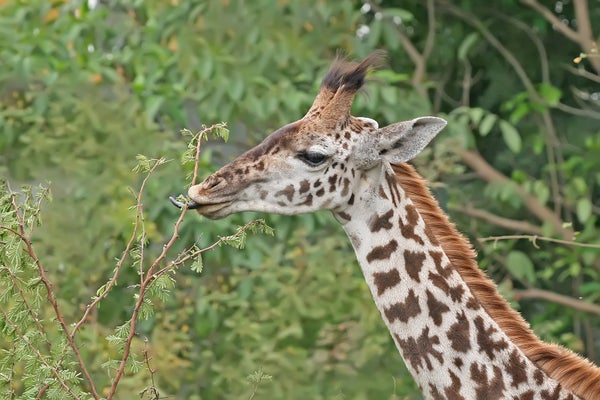
Giraffes have taught generations of students how evolution works. Not directly, of course. Communicating only through nocturnal humming is a barrier to classroom instruction. But the modern giraffe – Giraffa camelopardalis – is often used as the textbook example of why Darwin and Wallace were right and Lamarck was wrong.
The setup goes something like this. Think of a little protogiraffe gazing hungrily at some tasty leaves high up on a tree. Someone from the Lamarckian school of evolution, the argument goes, might assume that the little giraffoid would stretch its neck to grab the lowest of those high leaves and, through exertion, develop a longer neck that it would then pass on to its offspring. Repeat for best results. A Darwinian, on the other hand, would expect the protogiraffes to vary in neck length and those that just happened to have slightly longer necks would be able to reach more food, survive longer, and mate often enough to pass on that variation to the next generation, who would play out the scenario over again.
While the scenario is a bit of a caricature of what Lamarck actually thought, it’s still useful in getting at the basic evolutionary equation that Darwin and Wallace independently distilled. Yet, despite the thought experiment’s popularity, we’ve known little of how the giraffe actually got its neck. Today’s tall browsers definitely evolved from shorter-necked ancestors, but how? A new study by New York Institute of Technology’s College of Osteopathic Medicine anatomist Melinda Danowitz and colleagues provides an answer.
On supporting science journalism
If you're enjoying this article, consider supporting our award-winning journalism by subscribing. By purchasing a subscription you are helping to ensure the future of impactful stories about the discoveries and ideas shaping our world today.
Giraffes aren’t the only animals to have evolved impressively-long necks. The sauropod dinosaurs and aquatic plesiosaurs, for example, stretched out to ludicrous lengths both by adding additional vertebrae to the column and elongating those individual bones. But these saurians cheated by adding vertebrae during their evolution. Giraffes, by contrast, have the standard number of neck vertebrae shared by most mammals – seven – with the first element in the thoracic part of the spine being modified as a possible eighth neck bone. But that’s it. Evolution, constrained by mammalian anatomy, molded giraffes in a different way than the long-necked reptiles.
Danowitz and coauthors looked at anatomical landmarks on 71 giraffe vertebrae spanning 11 species from over 16 million years ago to the present, focusing on the second and third vertebrae in the neck. As it turns out, a proportionally-long neck isn’t new for these mammals.
The best candidate for a real protogiraffe, Prodremotherium, and an early giraffe named Canthumeryx already had neck bones that were long compared to their width. “[N]ot only did the giraffid lineage begin with a relatively elongated neck,” Danowitz and coauthors write, “but that this cervical lengthening precedes Giraffidae” – the giraffe subgroup typically thought of as encompassing all the long-necked forms.

Giraffe neck evolution. Credit: Danowitz et al. 2016
But even though the earliest giraffes already had slightly-elongated neck bones, there was no March of Progress towards towering heights. At least one – and possibly more – giraffe lineage reverted to abbreviated necks strung along stout vertebrae. Giraffokeryx was among the earliest of the short-necked giraffes, browsing low-lying foliage around 12 million years ago, and within the last three million years Sivatherium, Bramatherium, and the okapi followed suit. The short-necks proliferated alongside their lankier relatives, which is why we still have both short- and long-necked giraffes today.
Truly long-necked giraffes didn’t evolve until about 7.5 million years ago. Samotherium, Palaeotragus, Bohlinia, the extinct Giraffa sivalensis and the living Giraffa camelopardalis preserve enough transitional features to let Danowitz and colleagues reconstruct how this stretching occurred. It wasn’t simply a matter of drawing out their vertebrae as if they were in some sort of anatomical taffy pull. The front half of the neck vertebrae became elongated in Samotherium and Palaeotragus, generating forms intermediate between today’s Giraffa and their foreshortened predecessors. Then, within the last two millions years or so, the lineage leading up to the modern Giraffa elongated the back half of their neck vertebrae, giving them even more reach and making them literally at the top of their class.
If you could assemble all these fossil bits and pieces into a short film replaying giraffe evolution, you wouldn’t end up with the smooth transformation of a small-statured herbivore into a towering, checkered browser. There’d be starts and stops and side stories, the ending not being a goal but a happenstance. Time again to update those textbooks.
Reference:
Danowitz, M., Vasilyev, A., Kortlandt, V., Solounias, N. 2015. Fossil evidence and stages of elongation of the Giraffa camelopardalis neck. Royal Society Open Science. doi: 10.1098/rsos.150393
[This post was originally published at National Geographic.]

