
This article was published in Scientific American’s former blog network and reflects the views of the author, not necessarily those of Scientific American
We still live in the Age of Dinosaurs. We can rightly say that because they are as vibrant - if not moreso - than they have ever been, flourishing in forms from hummingbirds to vultures to penguins. But if I had to pick a group of animals who truly had a Mesozoic heyday - the fossil equivalent of peaking in high school - I’d have to say it was marine reptiles.
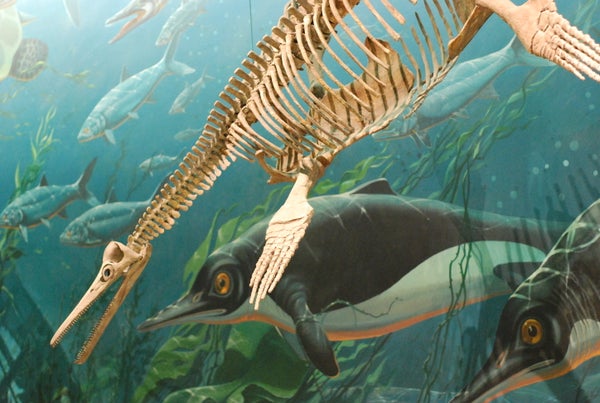
There are still seagoing reptiles sculling around. Sea turtles, sea snakes, marine iguanas, saltwater crocodiles, and the like. But, compared to the oceans of the Triassic, Jurassic, and Cretaceous, our seas are generally empty when it comes to scaly swimmers. From bottom to top, strata laid down by Mesozoic seas are brimming with plesiosaurs, ichthyosaurs, mosasaurs, as well as oddities like placodonts and hupehsuchians, and some of these groups overlapped in time for tens of millions of years.
But how did these communities of unusual reptiles evolve, and how did they shift with the constantly-changing conditions of their world? That’s what paleontologist Davide Foffa and colleagues examine in their new study of a particular section of Jurassic sea.
On supporting science journalism
If you're enjoying this article, consider supporting our award-winning journalism by subscribing. By purchasing a subscription you are helping to ensure the future of impactful stories about the discoveries and ideas shaping our world today.
The fossil library Foffa and colleagues selected is the Jurassic Sub-Boreal Seaway, preserved in the United Kingdom as a stack of rocks documenting the passage of about 18 million years. And to track the to-ings and fro-ings of marine reptiles, the researchers drew from that most common and durable part of the reptilian skeleton - teeth. That’s because teeth are not only abundant in these deposits, but they can act as rough guides to the sorts of animals present and what they were feeding on during their lives.
If you were able to jump overboard into the Jurassic Sub-Boreal Seaway, you’d likely find yourself among toothy and unfamiliar creatures. There were plesiosaurs - both the long-necked, small-headed and short-necked, big-headed varieties - as well as ichthyosaurs and at least three disparate types of marine crocodiles, all with varied teeth that Foffa and colleagues divided into categories such as crunch, smash, cut, pierce, and generalist. Many of the marine crocodiles and plesiosaurs, for example, had smooth-sided, thin teeth that match predators who pierce squirmy morsels, while many of the ichthyosaurs had teeth suited to smashing through prey with harder outer coverings.
But the critical factor here is time, how these categories shifted over 18 million years. Following previous research, the researchers point out, there appears to be a tight fit between tooth shape and feeding styles, and, within the record of the Jurassic Sub-Boreal Seaway, there doesn’t seem to be much overlap between the smashers, piercers, crunchers, and the rest. This is what ecologists know as niche partitioning - animals in the same place behaving in different ways, competition for resources driving disparate evolutionary expressions. This, Foffa and colleagues note, allowed a greater diversity of marine reptiles to live in the same place and add complexity to the food web (for example, large pliosaurs who ate other marine reptiles).
Despite such a long span of time, however, the researchers found an overall signal of stability rather than dramatic change. The guilds that existed in this seaway more or less stayed in place over the 18 million years, the marine reptile community - in outline - maintaining its disparity and feeding types through the span. Still, environmental shifts shook up the existing community now and then. Around 163 million years ago, for example, rising sea levels may have caused a disappearance of marine reptiles with piercing dentition who lived nearer to the shore. Over time, Foffa and colleagues write, these missing species were replaced by crocodiles able to take on larger prey and part of an ichthyosaur expansion that included species with piercing teeth. There were still smashers, crunchers, and so on, occupying their own niches, but sometimes who was doing the piercing or crunching changed.
Naturalists have seen changes like this before. Modern toothed whales like bottlenose dolphins and orcas show similar changes with shifting sea levels, the paleontologists write, deeper waters often favoring an abundance of large prey specialists while those who rely on piercing smaller fish become more scarce. More work needs to be done to investigate these shifts through time, but, Foffa and coauthors suggest, similar ecological responses to sea level “may indicate a conserved ecological structure near the top of ocean food webs over time.” We may have lost the most spectacular of the marine reptiles long ago, but we can still detect a whisper of what their world would have been like in the shifting nature of our modern oceans.