
This article was published in Scientific American’s former blog network and reflects the views of the author, not necessarily those of Scientific American
Marrow is tasty. I realize that’s a matter of personal taste, but, as far as the fossil and archaeological records show, our early human predecessors were fans of the soft and savory tissue.
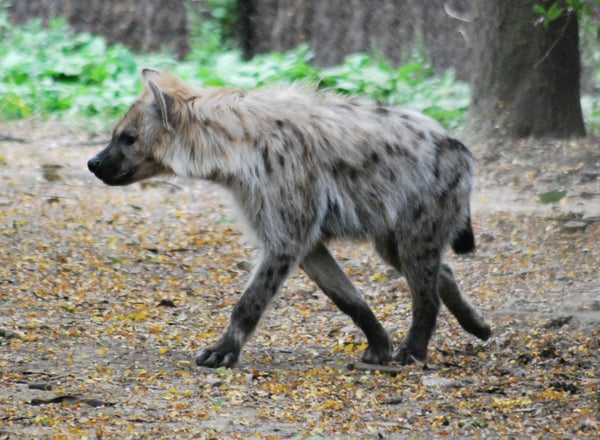
The nutritious content of a zebra or antelope was not constrained to flesh or viscera alone. Paleoanthropologists have been pointing out for decades that there was plenty of protein wrapped up in bones that could be pounded open with stone tools. The broken bones these mealtime efforts left behind help anthropologists track human dining habits over the years. But here’s the rub. What we learned to do through culture, spotted hyenas evolved to do with their jaws. In fact, hyenas and humans often showed up at the same carcasses, both parties licking their chops. So given that prehistoric hominins and hyenas both were capable of cracking bones, how can we tell who showed up for dinner from the piles of osteological fragments they left behind?
Pounding open a long bone with a hammerstone would have been all in a day’s work for a prehistoric human, but, for researchers trying to understand the past, replaying such moments takes great precision and care. That’s what anthropologist Reed Coil and colleagues tried to get their heads around in a new study comparing stone tool damage on mammal bones with the marks created by spotted hyenas.
On supporting science journalism
If you're enjoying this article, consider supporting our award-winning journalism by subscribing. By purchasing a subscription you are helping to ensure the future of impactful stories about the discoveries and ideas shaping our world today.
Conducting the study required some hands-on research. “We conducted bone breaking experiments using two different methods,” Coil and coauthors write, “breaking bones with a hammerstone on an anvil and feeding bones to a spotted hyena.” The result was an assemblage of farm-raised elk bones broken by both tools and teeth. Despite the very different methods of osteological destruction, though, the fracture patterns came out looking very similar.
When looking at breaks alone, Coil and colleagues found little difference between the damage created by hammerstones and those made by the very lucky spotted hyena at the Milwaukee County Zoo who got to participate in the experiment. Looking at the artificially-created assemblage, the hyena created more oblique fractures with angles further than 90 degrees than the hammerstones. A single bone wouldn’t be able to show you the difference, but, say, if you were looking at a cave floor full of broken bones, the result might help distinguish between humans and hyenas as the osteological accumulators.
Overall, though, the characteristics of the bones themselves were more important to how they fractured. We use the word “bone” both for the tissue and for entire elements, and while the tissue remains the same the traits of the tissue vary with size, age, anatomy, and species. The femur of a horse will break differently than that of an antelope, and a humerus will break different than a scapula will. In the case of the elk bones, breaks on the same element by tools or teeth were nearly indistinguishable. Whether being assaulted by hyenas or hammerstones, the bones themselves determine how they break.
Reference:
Coil, R., Tappen, M., Yezzi-Woodley, K. 2017. New analytical methods for comparing bone fracture angles: a controlled study of hammerstone and hyena (Crocuta crocuta) long bone breakage. Archaeometry. Doi: 10.1111/arcm.12285
