
This article was published in Scientific American’s former blog network and reflects the views of the author, not necessarily those of Scientific American
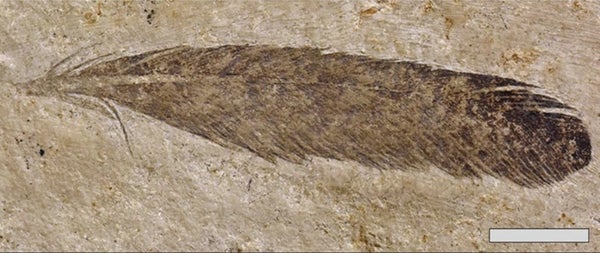
The tale is a classic part of dinosaurian lore. In 1860 or 1861, not very long after Charles Darwin’s On the Origin of Species made its debut, a delicately-preserved feather was found in the Jurassic limestone near Solnhofen, Germany. The two slabs that made up the fossil were clearly evidence of a bird much older than any found before, perhaps the very first, and so paleontologist Hermann von Meyer dubbed it Archaeopteryx lithographica – the old wing from the lithographic limestone. A skeleton found about that time seemed to fill in most of the rest of the animal, leaving paleontologists a-flutter about this creature that displayed characteristics of both birds and reptiles. Even though the Down House naturalist was reserved about what the skeleton meant, other experts immediately saw Archaeopteryx as a “strange being a la Darwin” that underscored transcendent evolutionary change as a reality.
But the tale now has a wrinkle in it. That first feather, the fossil initially used to name Archaeopteryx, probably doesn’t belong to the urvogel at all. The plume came from something else.
First, don’t fret about the name Archaeopteryx. Over a decade ago paleontologists moved to have the first known skeleton – known as the London specimen – designated as the new name-carrying fossil and standard bearer of the name Archaeopteryx. But the story of that first feather underscores the emerging realization that Archaeopteryxwasn’t the only feathered dinosaur strutting around the Jurassic islands of ancient Germany. There was an entire aviary.
On supporting science journalism
If you're enjoying this article, consider supporting our award-winning journalism by subscribing. By purchasing a subscription you are helping to ensure the future of impactful stories about the discoveries and ideas shaping our world today.
The feather has had a contentious history. Part of the problem is that part of the fossil seems to have gone missing. The original 19th century description mentions a calamus, or the anchoring point of the feather that makes up the part you dip into ink on a quill pen. To that end, paleontologist Thomas Kaye and colleagues used advanced imaging techniques to try and see some sign of the missing part.
Even though the calamus itself didn’t turn up, Kaye and coauthors report, there’s a “geochemical halo” left over from the structure that matches the original description. Those details, as well as recent assessments of Archaeopteryx feathers from the multiple specimens that have been found, indicates that the original feather probably comes from a different animal. The feather doesn’t match the primary, secondary, or tail feathers of Archaeopteryx. And while the researchers note that the isolated feather could be an Archaeopteryx covert or contour feather – a feather covering part of the wing or another area of the body – these bits of paleo plumage aren’t well-known in Archaeopteryx.
A future fossil may solve the mystery. Even though the fossils from Solnhofen have been known to researchers for nearly two centuries now, new discoveries are still being made. The small, fuzzy dinosaurs Juravenator and Sciurumimus – while not candidates for the feather’s owner – were described for the first time within the last 15 years, and various papers have suggested that some specimens labeled Archaeopteryx are actually different feathered dinosaur species. Perhaps paleontologists will eventually find a feathered dinosaur with a plume that matches the original feather von Meyer described.
The mystery remains. The original feather probably doesn’t belong to Archaeopteryx, so far as we currently understand, and may signal the existence of something else as-yet-undiscovered. The answer may still be locked in the vestiges of an ancient lagoon that passed down its fossilized secrets from Jurassic time.