
This article was published in Scientific American’s former blog network and reflects the views of the author, not necessarily those of Scientific American
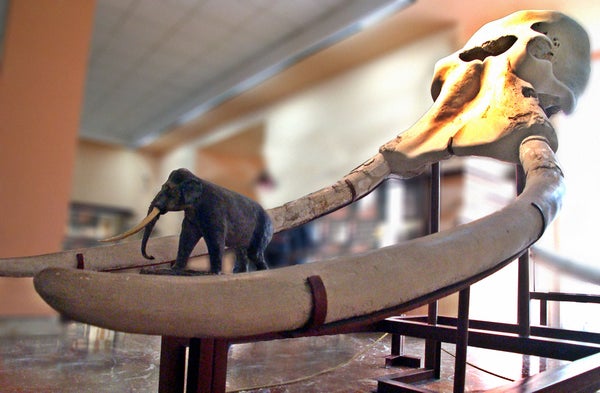
Mammoths certainly lived up to their names. They were not only enormous in size, but their fame often overshadows the other elephants that were roaming around during the Pleistocene. Among these Ice Age also-rans were the straight-tusked elephants of Eurasia, known to paleontologists as Palaeoloxodon, and a quartet of these fossils from Germany has just churned up what naturalists thought they knew about elephant evolution.
Up until now, Palaeoloxodon were thought to be close relatives of today’s Asian elephants. In fact, they seemed so similar to each other that some paleontologists considered the extinct straight-tusked elephants to belong to the same genus as the Asian elephant, Elephas. But after analyzing the ancient DNA recovered from four Palaeoloxodon uncovered in Germany – one site 244,000 years old, the other 120,000 years old – paleogeneticist Matthias Meyer and colleagues found a very different signature.

Where the straight-tusked elephant fits into the new family tree. Credit: Meyer et al 2017
On supporting science journalism
If you're enjoying this article, consider supporting our award-winning journalism by subscribing. By purchasing a subscription you are helping to ensure the future of impactful stories about the discoveries and ideas shaping our world today.
If the skeletal clues had been correct, the mitochondrial genomes of Palaeoloxodon should have compared most closely to today’s Asian elephants. Instead, Meyer and coauthors found that the straight-tusked elephants paleogenome was closest to that of today’s African forest elephant, Loxodonta cyclotis (itself only genetically distinguished from African bush elephants in 2010). This not only shuffles the straight-tusked elephants into a new place on the pachyderm family tree, but it alters what paleontologists thought about the long history of elephants.
The straight-tusked elephant is now an example of convergent evolution, starting from an ancestor that had more in common with African elephants but becoming anatomically more like Asian elephants. That also means that the behemoth branch that led to today’s African elephants – which was always assumed to have been isolated in Africa – actually left the continent and proliferated through Eurasia.
Elephant skeletons can be deceiving. Paleogeneticists had already highlighted this with the discovery that all of North America’s mammoths – previously split into three or four different species – actually interbred with each other and may represent a single, highly-variable species. The unexpected placement of Palaeoloxodonta only highlights how elephant evolution is far more complicated than anyone previously realized. As we race to save the last living elephants from extinction, we’re only just starting to understand the nuances of their evolutionary backstory.
Reference:
Meyer, M., Palkopoulou, E., Baleka, S., Stiller, M., Penkman, K., Alt, K., Ishida, Y., Mania, D., Mallick, S., Meijer, T., Meller, H., Nagel, S., Nickel, B., Ostritz, S., Rohland, N., Schauer, K., Schüler, T., Roca, A., Reich, D., Shapiro, B., Hofreiter, M. 2017. Palaeogenomes of Eurasian straight-tusked elephants challenge the current view of elephant evolution. eLife. doi: 10.7554/eLife.25413

