
This article was published in Scientific American’s former blog network and reflects the views of the author, not necessarily those of Scientific American
Sexing a dinosaur isn’t easy.
As far as gross skeletal anatomy is concerned, male and female dinosaurs are practically identical. The shape of saurian bones offers no help. So far as anyone has been able to tell, the skeletons of dinosaurs were not markedly sexually dimorphic (or, in other words, different between males and females). Even in highly-ornamented species of horned dinosaurs, armored dinosaurs, and others, all the gnarly spikes, plates, and crests don’t show a definitive split in form that can be taken as a marker of different sexes.
But the external anatomy of bones isn't everything. A pair of surprises provided opportunities for paleontologists to identify some female dinosaurs, at least. In 2005 paleontologist Tamaki Sato and coauthors reported on a fossil of a parrot-like oviraptorosaur that had been preserved with a pair of eggs nestled between her hip bones. This dinosaur was definitely a female.
On supporting science journalism
If you're enjoying this article, consider supporting our award-winning journalism by subscribing. By purchasing a subscription you are helping to ensure the future of impactful stories about the discoveries and ideas shaping our world today.
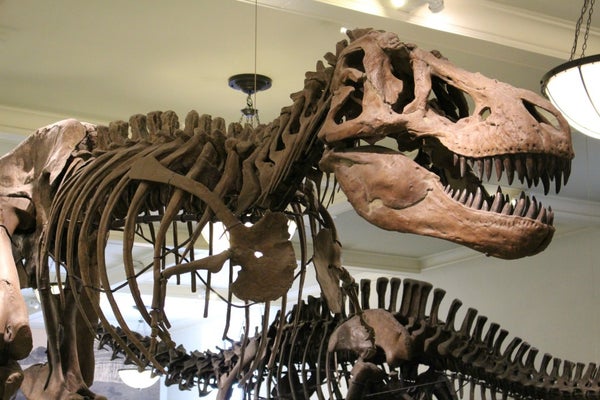
The next find came fast. Just a few months later, molecular biologist Mary Schweitzer and her colleagues reported on another way female dinosaurs could be identified through their pregnancies. A thigh bone of a Tyrannosaurus rex—MOR 1125 or “B. rex” to fossil fans—has a special tissue inside the main cavity called medullary bone. The same type of bone is seen in living birds, and is laid down when estrogen skyrockets following ovulation. In short, if you see medullary bone, you’ve found a pregnant female.
Not everyone agreed with this interpretation. Other experts suggested that the messy, rapidly-deposited bone tissue inside the T. rex was from a disease and that similar types of bone found in the jaws of male and juvenile pterosaurs—the flying relatives of dinosaurs—meant that medullary bone can’t be taken as a reliable indicator of a dinosaur’s sex.
But Schweitzer and a multidisciplinary team of experts have now answered these criticisms with a new study of the original T. rex clue. What did they find? That MOR 1125 truly was pregnant when she died.

Credit: Mark Hallett
Schweitzer and her colleagues approached the fossil from multiple avenues, re-examining the structure of the peculiar bone tissue with CT scans but also looking at its chemical composition. This is the key in teasing out tricky tissues, the researchers write, because medullary bone is chemically different from other bone types.
True medullary bone contains a higher proportion of mineral content and biomolecules called glycoaminoglycans than the surrounding tissue. So when the researchers used a stain to reveal the presence of biomolecules known to be abundant in medullary bone, the reaction fit with what they had suspected: the stain literally highlighted the fact that MOR 1125 had a femur infilled with the mineral-rich tissue.
The bone in MOR 1125 was not a pathology, and the superficially similar tissues in the pterosaurs must be attributable to some other condition or process. (Medullary bone is estrogen-dependent, Schweitzer and coauthors point out, so similar tissues in male and immature animals have to be something different.)
Gravid dinosaurs really did lay down true medullary bone inside themselves, and this discovery holds fantastic possibilities for investigating how dinosaurs actually lived. But there’s a more subtle point that’s just as important to the way we think about these animals.
In fossiliferous shorthand, it’s easy to say that dinosaurs turned to rock during their long tenure in the earth. And yes, their bones and other tissues come down to us as permineralized versions of the originals. But it’s not as if everything of the real creatures was obliterated.
“Original organic components are assumed to be completely destroyed during burial and fossilization processes over millions of years,” Schweitzer and colleagues write. “However, we have shown that tissues, cells, and fragments of original molecules can persist across geological time.” Dinosaurs didn’t turn to stone like mythological trolls caught in sunlight. After all this time, tatters of the living creatures remain. Look at dinosaurs as once-living animals, not piles of bone-shaped rocks, and you can start to see them.
References:
Schweitzer, M., Zheng, W., Zanno, L., Werning, S., Sugiyama, T. 2016. Chemistry supports the identification of gender-specific reproductive tissue in Tyrannosaurus rex. Scientific Reports. doi: 10.1038/srep23099
Schweitzer, M., Wittmeyer, J., Horner, J. 2005. Gender-specific reproductive tissue in ratites and Tyrannosaurus rex. Science. doi: 10.1126/science.1112158
[This post was originally published at National Geographic.]
