
This article was published in Scientific American’s former blog network and reflects the views of the author, not necessarily those of Scientific American
I’ve spilled more than a little digital ink over the top carnivores of the Jurassic west. Allosaurus, Ceratosaurus, and Torvosaurusare all very dinosaur-y dinosaurs, checking the boxes for big, scary, and strange. But as I’ve poked around the Morrison Formation bones held at the Natural History Museum of Utah over the past few weeks, I realized I’ve done a disservice to ancient ecology by focusing on the flesh-rippers of the most imposing stature. There was an entire guild of Jurassic carnivores running around North America around 150 million years ago, and one of the least-known – at least to the public – is a mid-sized carnivore named Marshosaurus bicentesimus.
We know Marshosaurus was part of an wide array of predators, from tiny to giant, because of where it was found. The theropod’s bones were scattered through the jumble that is Utah’s Cleveland-Lloyd Dinosaur Quarry. Allosaurus totally dominates this site, but the bonebed has also yielded Ceratosaurus, Torvosaurus, a small tyrannosaur named Stokesosaurus, and, as James Madsen, Jr. announced in 1976, Marshosaurus.

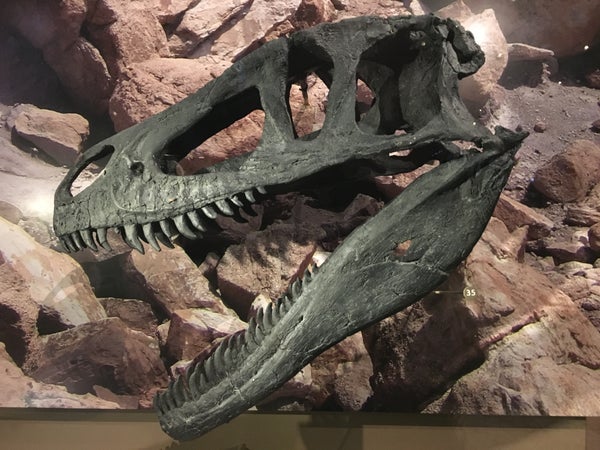
Marshosaurus at the Natural History Museum of Utah. Credit: Brian Switek
On supporting science journalism
If you're enjoying this article, consider supporting our award-winning journalism by subscribing. By purchasing a subscription you are helping to ensure the future of impactful stories about the discoveries and ideas shaping our world today.
Madsen, Jr. made his case on a collection of hip bones and jaw elements that represented at least two individuals of 15-foot-long carnivorous dinosaur. That might not seem like much to go on, but the size and anatomy of Marshosaurus in comparison to its neighbors confirmed that the predator was something never before seen. This was a dinosaur that was larger than the sleek little Stokesosaurus but smaller than the biggest predators, more in the size range of a young subadult Allosaurus.
The trouble with Marshosaurus was that it was either a very rare dinosaur or it more regularly lived in environments away from the floodplains where so many of its neighbors became buried. Only a few pieces have been found at other sites, such as Dinosaur National Monument, and so most of the skeleton remains unknown. The features paleontologists have been able to spot on the assembled bones have narrowed the dinosaur’s identity down to some sort of megalosaur – a cousin of its larger competitor Torvosaurus – but, for the most part, Marshosaurus remains as much of a mystery now as it was in 1976.
In order to solve the puzzle, we need more puzzle pieces. And I’m hopeful that future fieldwork might do just that. This past summer, while I was scratching away at another site near the main bonebed, paleontologists and volunteers from the University of Wisconsin, Oshkosh moved tons of limestone to expose a fresh surface of the Cleveland-Lloyd Dinosaur Quarry. Every bone, every fragment is going to be carefully uncovered and documented when next summer raises the eastern Utah temperature to a setting fit for paleontology. If we’re lucky, more Marshosaurus might be waiting just below the surface.
Reference:
Madsen, J. 1976. A second new theropod dinosaur from the Late Jurassic of east central Utah. Utah Geology. 3 (1): 51-60
