
This article was published in Scientific American’s former blog network and reflects the views of the author, not necessarily those of Scientific American
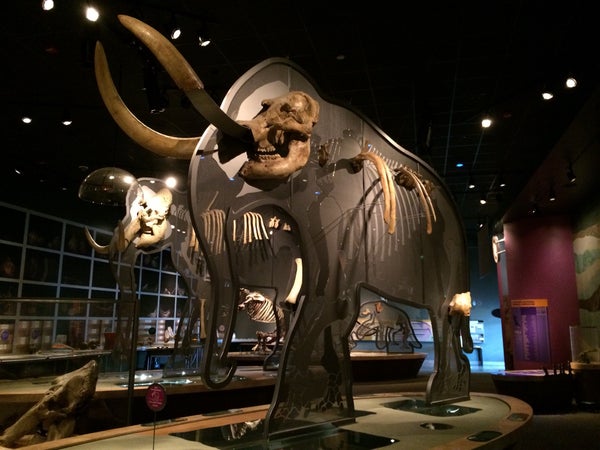
Max is an impressive mastodon. Reconstructed at Hemet, California’s Western Science Center, this Pleistocene celebrity cuts an imposing Ice Age figure in the museum hall. But Max isn’t quite like other mastodons you may have seen. The beast is the prime example of a new species – the first new mastodon named in half a century.
The American mastodon – Mammut americanum – is a real rock star among prehistoric mammals. Even before people knew what this creature was, its remains inspired awe as the “American incognitum.” The bones and teeth of the American mastodon also figured prominently in Georges Cuvier’s famous proof that extinction is a reality at the end of the 18th century. In time, though, it seemed that there was only one American mastodon that lived from coast to coast. From teeth rolled up onto the New Jersey shore to skeletons excavated from Midwest farms to the tar-soaked bones of La Brea, all were Mammut americanum.
But Max ended up being the keystone to a discovery that had been waiting in the collections of the Western Science Center. Described by paleontologist Alton Dooley and a team of five other researchers, Max and other mastodons west of the Sierra Nevada Mountains represent a different species. These Ice Age beasts are Mammut pacificus, the Pacific mastodon.
On supporting science journalism
If you're enjoying this article, consider supporting our award-winning journalism by subscribing. By purchasing a subscription you are helping to ensure the future of impactful stories about the discoveries and ideas shaping our world today.
The distinctive molars of these mastodons are part of what sets them apart. The grinders are consistently narrower than those of eastern mastodons, Dooley and colleagues note. Max and friends also have six vertebrae in the sacral portion of their hips, thigh bones that are thicker in the middle section, and lack the tiny lower jaw tusks sometimes seen in Mammut americanum.
So far, Mammut pacificus has turned up throughout California and in southern Idaho. The more widespread Mammut americanum, which lived at the same time, had a much broader range – from the Yukon through the Pacific northwest, the Four Corners, and east to the Atlantic coast. (Mastodons that roamed Utah and Nevada, right in the middle, live right at the apparent boundary but need to be reassessed.) The question is why the western mastodons split off into their own distinctive anatomical species.
Even though Mammut is an “Ice Age” mammal, this elephant was a forest browser that thrived in wetter, forested habitats. Mastodons generally were not rubbing shoulders with woolly mammoths out on the grassy steppe. Given that Mammut had “stringent” requirements for water and vegetation, Dooley and colleagues note, it’s possible that patchiness of western habitats – because of elevation changes, differences in local climate, or similar ecological boundaries – may have fostered isolation that allowed Mammut pacificus to evolve.
The story of this beast is only just starting to be told. Now that a new mastodon has been recognized, there are dozens of questions to ask about how this species originated, why, whether it overlapped with Mammut americanum, and the circumstances under which these mastodons ultimately disappeared. But there’s an even broader lesson to be gleaned from the discovery.
Mammut pacificus is not based on a single specimen freshly dug out of the ground. The remains of Max and friends were unearthed in the 1990s as part of the Diamond Valley Lake excavations to rescue fossils during the creation of the reservoir. These animals were assumed to be Mammut americanum before Dooley and colleagues noticed that Max’s molars were awfully small for the skeleton’s size, leading to a broader investigation that underscored that the fossils at the Western Science Center – and elsewhere – represented a species that had been hiding in museum drawers all this time. Moments of exciting discovery don’t always happen out in the field. Rather than pick and shovel, sometimes finding a new species relies on persistence and asking the right questions.