
This article was published in Scientific American’s former blog network and reflects the views of the author, not necessarily those of Scientific American
A good dinosaur is hard to find.
I've previously laid blame on Jurassic Park for popularizing the idea that paleontologists regularly find stunning, intact, articulated dinosaur skeletons. The truth requires quite a bit more consolidant and frustrated queries along the lines of "Where's the rest of it?" But museums have their roles to play, too. We wish to see dinosaurs fully restored - not just the butt half of a skeleton - and this can leave us with the impression that finding a crisp, complete, and undistorted dinosaur happens all the time.
Perhaps "complete" isn't a word we should even use in reference to dinosaur fossils. It's often difficult to tell exactly what complete is after taphonomy has taken its toll, discarding some hard tissues as well as the bonus soft tissue remnants we all hope for. And this is why the anatomical aspect of paleontology is always a comparative science, with new finds being compared to what's been seen before. Missing parts in one skeleton can be substituted with bones from a relative as a working hypothesis and placeholder. And every now and then, a lucky find helps provide more grist for the osteological mill.
On supporting science journalism
If you're enjoying this article, consider supporting our award-winning journalism by subscribing. By purchasing a subscription you are helping to ensure the future of impactful stories about the discoveries and ideas shaping our world today.
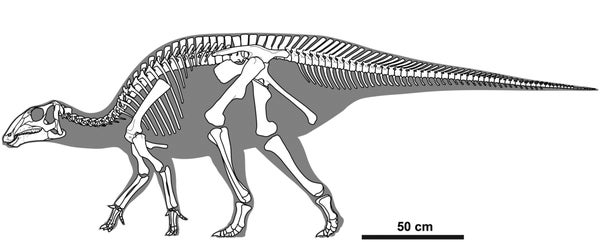
Gobihadros mongoliensis, a duckbill dinosaur just described by paleontologist Khishigjav Tsogtbaatar and colleagues, is a great example. In technical terms, this roughly 100-million-year-old dinosaur is a "non-hadrosaurid hadrosauroid." That means it belongs to the greater family of shovel-beaked herbivores commonly known as duckbills, but lacks some of the features that would place this dinosaur closer to famous favorites like Parasaurolophus and Edmontosaurus. In other words, Gobihadros is in between the more Iguanodon-like ancestors of hadrosaurs and later species in both time and anatomy.
The wonderful set of remains described by Tsogtbaatar and coauthors drive home the point. Gobihadros is the first dinosaur of its kind to be found in the Late Cretaceous of central Asia from extensive remains, including an articulated skull, providing a rare picture of this veggiesaur and its relatives. Not only does Gobihadros seem to show some convergent characteristics with later duckbills, indicating features of the jaws and hips evolved more than once, but the hadrosaur also has a thumb spike similar to its more ancient relatives. This makes Gobihadros what experts sometimes call a mosaic - an animal that has prominent similarities to both earlier and later species from the same group, yet still on an evolutionary branch of its own instead of slotted onto a straight line of progress.
Reconstructed from snout to tail from multiple specimens, Gobihadros slides into the family tree alongside previously-named relatives like Bactrosaurus and Gilmoresaurus. And so Gobihadros becomes an important point of comparison, perhaps unlocking how hadrosaurs flourished and became iconic parts of Late Cretaceous life. The dinosaurs themselves couldn't have known this for a variety of reasons, but, thanks to the hindsight granted to us 100 million years later, we can perceive how this exquisite dinosaur fit into hadrosaur history.