
This article was published in Scientific American’s former blog network and reflects the views of the author, not necessarily those of Scientific American
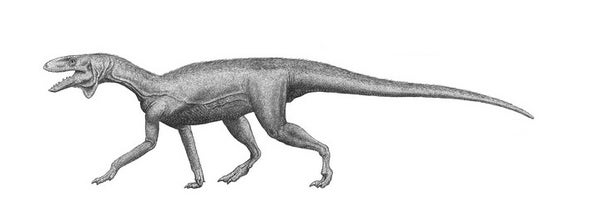
What’s almost a dinosaur, but not quite? The answer, as paleontologists have come to understand, is “a silesaur!”, a non-dinosaurian dinosauromorph. I know that’s a bit of a mouthful. Let’s unpack that.
Silesaurs aren’t exactly famous in fossil circles yet. The iconic member of the group, Silesaurus, was named in 2003 and the group’s identity wasn’t fully recognized until 2010. As old as they are, dating back through the Middle and Late parts of the Triassic, they’re pretty new on the Mesozoic block. And they’re important to our understanding of how dinosaurs evolved. Silesaurs are not technically dinosaurs, but they’re close relatives that belong to the larger group which dinosaurs are nested in. That’s why they’re called non-dinosaurian dinosauromorphs – in short, protodinos. And paleontologists Jeffrey Martz and Bryan Small have just named a new one from Colorado.
The new silesaur, known from parts of the skull and body, is named Kwanasauruswilliamparkeri and lived more than 207 million years ago. Its name is a combination of Ute and Greek meaning “eagle lizard,” while the species name honors influential Triassic paleontologist Bill Parker. It’s the fourth silesaur known from North America, and the latest of 11 described so far.
On supporting science journalism
If you're enjoying this article, consider supporting our award-winning journalism by subscribing. By purchasing a subscription you are helping to ensure the future of impactful stories about the discoveries and ideas shaping our world today.
But Kwanasaurus isn’t quite like other silesaurs. The dinosaur’s teeth and jaws, Martz and Small write, seem better-adapted to shearing plants than the more omnivorous lifestyle expected of these animals. Then again, coprolites attributed to silesaurs have been found with beetle pieces in them, and, as Martz and Small note, the dietary flexibility of silesaurs might have allowed for their evolutionary success through the Triassic as they evolved alongside their dinosaur relatives.
There are undoubtedly other silesaurs to find. As it stands now, it seems like silesaurs evolved in the southern part of the supercontinent Pangaea during the Early or Middle part of the Triassic before spreading around the world. They give us a rough picture of what the ancestors of the first dinosaurs were like, yet they thrived alongside the earliest dinosaurs and evolved in their own ways. Ultimately, for reasons that remain unknown, the silesaurs disappeared as their dinosaurian relatives gained greater prominence, but, given their Triassic tenure, they embodied both the past and future of the Age of Reptiles as they strut alongside the “terrible lizards.”