
This article was published in Scientific American’s former blog network and reflects the views of the author, not necessarily those of Scientific American
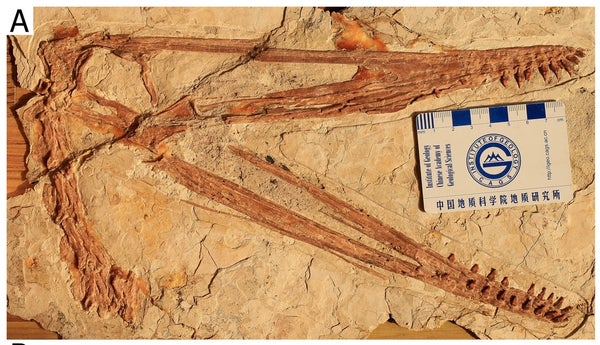
Paleontologists are accustomed to finding headless vertebrate fossils. Skulls or their component bones – prized for what their details can reveal about diet, evolutionary relationships, and other specifics – are often fragile or easily detached from the rest of the body, tumbled away or utterly destroyed. This makes Nurhachius luei a departure from taphonomic tradition. This new pterosaur, named by paleontologist Xuanyu Zhou and colleagues, is principally known from the skull and a few neck vertebrae.
The fossil itself, known as BPMC-0204 to experts, is a charmer. This particular pterosaur was preserved with a gaping, 125 million-year-old grin. If I didn’t know better I’d presume that this Nurhachius died while laughing to itself over a bawdy joke that some other Mesozoic creature took grave exception to.
Getting down to the anatomical nitty-gritty, Zhou and coauthors propose that BPMC-0204 represents a new species of Nurachius, slightly different from Nurhachius ignaciobritoi and designated as Nurachius luei in honor of pterosaur expert Junchang Lü. Going up a level of systematic focus, this strange Cretaceous flier belonged to a family of pterosaurs called istodactylids that are recognized by their long skulls and “rhombic teeth.” The species that carries the banner for the family – Istiodactylus itself – was the only member of this group for more than a hundred years, until, as the study authors note, three new species have been recognized in the last fifteen. Pterosaur professionals are just getting to know this toothy group.
On supporting science journalism
If you're enjoying this article, consider supporting our award-winning journalism by subscribing. By purchasing a subscription you are helping to ensure the future of impactful stories about the discoveries and ideas shaping our world today.
The question is how Nurachius luei made a living in its ancient ecosystem, and why it wound up preserved in a place with so many other pterosaur species. Over 23 pterosaur species have been named from the same rock unit, known to paleontologists as the Jiufotang Formation. That’s not to say that all lived at the same time. The formation ranges from over 670 to over 8,800 feet thick, preserving a time span between 125 and 113 million years. If anything, 23 pterosaur species seems low when spread over that timespan. Then again, the known pterosaurs are not spread evenly. Most are found in the lower part of the formation in strata that have yielded feathered dinosaurs like Microraptor.
At this point, parsing pterosaur secrets requires a consideration of both the living and dead animals. Did Nurachius live in the place that it died, or was this particular specimen a traveler from elsewhere? If the pterosaur truly lived in the area where it became fossilized, was it a common species or a rare one? Did it live alongside close-relatives, or was it part of a varied pterosaur community that carved out varied lifestyles in order to coexist? And on that point, there’s always the question of whether seemingly unique species are really age stages of already-known pterosaurs, altering the count of who was around at a particular time.
Paleontologists don’t have this kind of resolution for Nurachius yet. In many formations, simply doing a count of who was present is a monumental and ongoing task. But every time a new fossil species is found, we can start asking deeper and more detailed questions. No ancient organism lived in isolation. Naming an animal is just the first step towards understanding the prehistoric moments it was a part of.