
This article was published in Scientific American’s former blog network and reflects the views of the author, not necessarily those of Scientific American
The dinosaur was waiting in a box. A label on its container read “Atouguia da Baleia,” a reference to where the bones had been found over a half century before, with additional scattered pieces strewn through a collection of ankylosaur bones at the Laboratório Nacional de Energia e Geologia in Portugal.
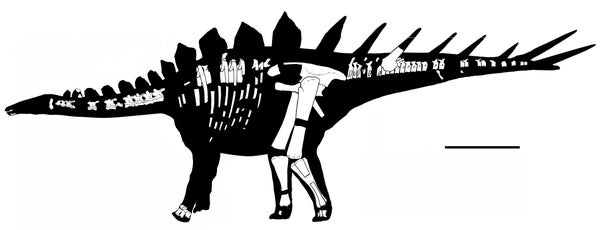
The skeleton had once made up most of an armored dinosaur that roamed western Europe during the Late Jurassic, when armored dinosaurs had fully come into their own, but its importance wasn’t realized until a different discovery put the forgotten bones into context and the bones were cleaned. The fossils, write paleontologists Francisco Costa and Octávio Mateus, make up another specimen of the long-necked stegosaur Miragaia longicollum, and they help add context to how different spike-tailed dinosaurs were related to each other.
The name-holding specimen for Miragaia, described in 2009, is a gorgeous fossil that offers a good look at the front half of the dinosaur. But what about the back half, including the famously spiky stegosaur tail? That had to be inferred from related animals. The newly-recognized fossil, known as MG 4863, preserves bones of the midsection, hips, hind legs, and tail, filling in much of what was missing from the first Miragaia. Instead of having plates running down the entirety of the back, for example, the second skeleton indicates that Miragaia was like other stegosaurs in having large spikes jutting out from the base of the tail to the “thagomizer” at the end.
On supporting science journalism
If you're enjoying this article, consider supporting our award-winning journalism by subscribing. By purchasing a subscription you are helping to ensure the future of impactful stories about the discoveries and ideas shaping our world today.
Within the stegosaur family tree, Miragaia comes out within a puzzling group called dacentrurines. The collection includes some of the earliest stegosaurs named, such as Dacentrurus itself, but has only been recently recognized as experts have gone back to sort through the comparatively rare remains of the charismatic saurians. And a more complete vision of Miragaia furthers those efforts. Not only does overlapping skeletal material indicate that Miragaia and Dacentrurus are close relatives, but, Costa and Mateus propose, it seems that a previously-known stegosaur called “Alcovasaurus” is actually a second species of Miragaia that should be dubbed Miragaia longispinus.
Future analyses will test the idea that “Alcovasaurus” is Miragaia, but, either way, the dinosaurs were very close relatives who lived on different continents. And if we have Miragaia longocollum in prehistoric Europe and Miragaia longispinus in North America, the dinosaurs might provide another line of evidence that there was a long-lost land bridge between the landmasses. Such a connection has been suggested before on the basis of other animals – the predatory Torvosaurus tanneri is found both in the Late Jurassic of Portugal and the American west, for example – but the taxonomic reshuffling would add an entire group of stegosaurs in the prehistoric Americas that were previously thought to have been exclusive to paleoEurope.
But perhaps the most important thing that the newly-recognized Miragaia specimen reminds us is that paleontology relies on comparison. Fossils that were considered uninteresting, unremarkable, or were even simply forgotten can take on new importance in the reflection of additional finds. Just like fossil bones themselves, the significance of some fossils takes time and patience to uncover.