
This article was published in Scientific American’s former blog network and reflects the views of the author, not necessarily those of Scientific American
The fossil record is always changing. That might seem strange to hear about something that is literally supposed to be set in stone, but that's simply the nature of science. There are the facts and then there are the ways that we understand and interpret them. This is what gives science its resilience - even when you make a mistake, you learn something new. For example, when bits and pieces of previously-collected protomammal turned out to be a brand new species.
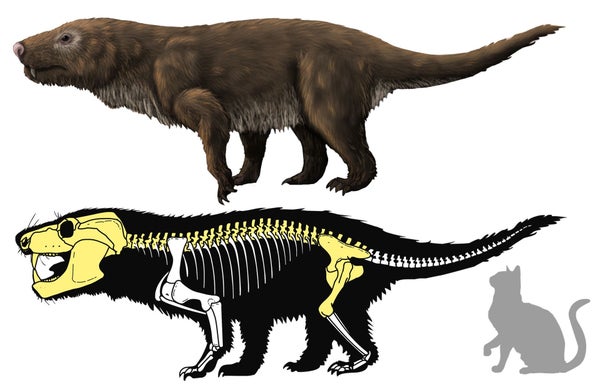
Paleontologist Agustin Martinelli and colleagues tell the story in their new paper describing an animal they've named Aleodon cromptoni.
The tale goes back to 1933. In that year the fossil hunter Rex Parrington found a partial skull and jaws of a weasel-like protomammal in the Triassic rock of Tanzania. In 1955, paleontologist Alfred "Fuzz" Crompton named this animal Aleodon brachyrhamphus, one of the cynodonts. Much later, additional material referable to Aleodon turned up in Namibia, too, marking this animal as a denizen of ancient Africa.
But now Aleodon has turned up in South America. The new species named by Martinelli and colleagues is based on an array of fossils found in Brazil. Most of these were previously attributed to an animal called Chiniquodon, but, according to the new study, these fossils have more in common with the fossils from Africa and merit relabeling as a new species of Aleodon.
This is about more than some taxonomic reshuffling. Paleontologists working on understanding evolution during the Triassic - when life was roaring back from the worst mass extinction of all time - often correlate fossil beds according to the species found within them. Knowing Aleodon was present in Brazil as well as various locations in Africa will help paleontologists better understand who was alive and when, highlighting patterns of evolution during this critic time in life's history.

The skull of Aleodon cromptoni. Credit: Martinelli et al 2017
On supporting science journalism
If you're enjoying this article, consider supporting our award-winning journalism by subscribing. By purchasing a subscription you are helping to ensure the future of impactful stories about the discoveries and ideas shaping our world today.
Fossil Facts
Name: Aleodon cromptoni
Meaning: The species name cromptoni is named in honor of paleontologist Alfred "Fuzz" Crompton who originally described the genus Aleodon.
Age: Triassic, around 235 million years old.
Where in the world?: Rio Grande do Sul, Brazil.
What sort of organism?: A protomammal called a cynodont.
How much of the organism’s is known?: Various specimens representing different parts of the skeleton and life stages.
Reference:
Martinelli, A., Kammerer, C., Milo, T., Paes Neto, V., Ribeiro, A., Da-Roda, Â., Schultz, C., Soares, M. 2017. The African cynodont Aleodon (Cynodontia, Probainognathia) in the Triassic of southern Brazil and its biostratigraphic significance. PLOS ONE. doi: 10.1371/journal.pone.0177948
Previous Paleo Profiles:
The Light-Footed Lizard The Maoming Cat Knight’s Egyptian Bat The La Luna Snake The Rio do Rasto Tooth Bob Weir's Otter Egypt's Canine Beast The Vastan Mine Tapir Pangu's Wing The Dawn Megamouth The Genga Lizard The Micro Lion The Mystery Titanosaur The Echo Hunter The Lo Hueco Titan The Three-Branched Cicada The Monster of Minden The Pig-Footed Bandicoot Hayden's Rattlesnake Demon The Evasive Ostrich Seer The Paradoxical Mega Shark The Tiny Beardogs The Armored Fish King North America's Pangolin The Invisible-Tusked Elephant The Mud Dragon The Spike-Toothed Salmon The Dream Coast Crocodile Buriol's Robber Ozimek's Flyer The Northern Naustoceratopsian The High Arctic Flyer The Tomatillo From the End of the World The Short-Faced Hyena The Mighty Traveler from Egg Mountain Keilhau's Ichthyosaur Mexico's Ancient Horned Face Mauricio Fernández's Plesiosaur New Zealand's Giant Dawn Penguin The Orange Sea Lion Mongolia's Ginkgo Cousin The Geni River Frog Isabel Berry's Dinosaur The Whale Caiman The Moab Lizard Yang Zhongjian's Lizard The Little Anubis The Shuangbai Lizard The Wyvern Dinosaur The "Need Helmet" Dinosaur The Jianianhua Dragon The Liaoning Hunter The Dalian Lizard
