
This article was published in Scientific American’s former blog network and reflects the views of the author, not necessarily those of Scientific American
The story of mammalian evolution is often told through teeth. Enamel makes teeth sturdy, giving them a better shot at entering the fossil record than bone, and mammal teeth are often so distinctive than experts can identify species from dental records alone. When paleontologists discover the skulls and jaws those teeth fit into, though, the big picture can change, as just happened to a beast that used to go by the name of Rhagatherium aegyptiacum.
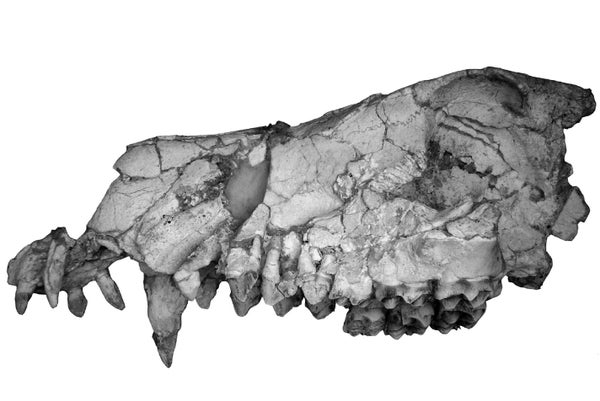
Back in 1906 the paleontologist Charles William Andrews looked at a molar found in the roughly 30-million-year-old rock of Fayum, Egypt and concluded that it represented a new species of an animal known as Rhagatherium. Now it's clear that the animal Andrews described was more distinctive than that single tooth hinted. From a smushed skull, multiple pieces of jaw, and teeth, paleontologist Afifi Sileem and coauthors have renamed the Fayum creature Nabotherium aegyptiacum.
There's nothing quite like Nabotherium alive today. In broad terms, the beast was an anthracothere - a group of mammals closely tied to the origins of hippos. Multiple anthracotheres had been found in the Fayum before. But Nabotherium stands out by having a short snout, molars that are lower and more rounded, and big canine teeth that give this beast its name. This group of traits, Sileem and coauthors write, probably means that Nabotherium was "a more eclectic frugivore/herbivore" than its relatives. Whatever Nabotherium ate, though, this beast's canines give its skull a smile that can only be described as sharp.

Stereophotos of the skull of Nabotherium, as seen from beneath. From Sileem et al., 2016.
Fossil Facts
On supporting science journalism
If you're enjoying this article, consider supporting our award-winning journalism by subscribing. By purchasing a subscription you are helping to ensure the future of impactful stories about the discoveries and ideas shaping our world today.
Name: Nabotherium aegyptiacum
Meaning: Nabotherium is a combination of the Arabic word for canine tooth and the Greek word for beast, while aegyptiacum references the mammal's discovery in Egypt.
Age: Oligocene, around 30 million years old.
Where in the world?: Fayum, northern Egypt.
What sort of critter?: An anthracothere, or a mammal related to early hippos.
Size: Said to be a "medium-sized" anthracothere.
How much of the creature’s body is known?: A crushed skull, several lower jaws and tooth-bearing fragments, and a palate.
Reference:
Sileem, A., Sallam, H., Hewaidy, A., Miller, E., Gunnell, G. 2016. A new anthracothere (Artiodactyla) from the early Oligocene, Fayum, Egypt, and the mystery of African 'Rhagatherium' solved. Journal of Paleontology. doi: 10.1017/jpa.2016.13
Previous Paleo Profiles:
The Light-Footed Lizard The Maoming Cat Knight’s Egyptian Bat The La Luna Snake The Rio do Rasto Tooth Bob Weir's Otter
