
This article was published in Scientific American’s former blog network and reflects the views of the author, not necessarily those of Scientific American
In broad strokes, figuring what a dinosaur ate is simple. Carnivores, herbivores, and omnivores are separated from each other on the basis of their teeth and other anatomical clues. But in trying to envision what these unusual animals were like in life - and understand their ecology - these traditional categories are far too broad and hardly satisfying. When we ask "What did this dinosaur eat?", "Plants" isn't much of an answer. Fortunately for us, sometimes dinosaur skeletons come with remnants of their last meals.
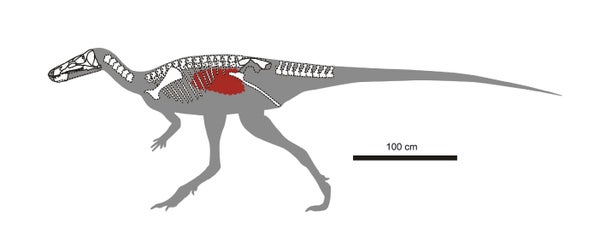
Isaberrysaura is a relatively new dinosaur on the block, named by paleontologist Leonardo Salgado and colleagues earlier this year. This 170 million year old creature was one of the ornithischians, close to the base of a dinosaur family that would come to include rock stars like Iguanodon and Edmontosaurus. But the most remarkable thing about this dinosaur, the researchers reported, was what was found inside its body cavity.
From the teeth alone, Isaberrysaura looked a good candidate for an herbivore. Its small, leaf-shaped teeth were better suited to cropping vegetation and cutting flesh. But the real confirmation of its diet comes from cycad seeds fossilized within the dinosaur's gut.
The preservation of the seeds indicate that they were "gobbled down, and not chewed", Salgado and coauthors wrote. That makes sense given that dinosaurs like Isaberrysaura could not chew. But beyong mere association, this raises the prospect of ecological ties we would have otherwise been blind to. The sturdy cycad seeds likely passed through living Isaberrysaura digestive systems intact, deposited in various places as the dinosaur roamed. Isaberrysaura may have been a seed disperser, planting the Jurassic garden.

The skull of Isaberrysara. Credit: Salgado et al. 2017
Fossil Facts
On supporting science journalism
If you're enjoying this article, consider supporting our award-winning journalism by subscribing. By purchasing a subscription you are helping to ensure the future of impactful stories about the discoveries and ideas shaping our world today.
Name: Isaberrysaura mollensis
Meaning: Isaberrysara honors Isabel Valdivia Berry, who found the dinosaur, and mollensis is a reference to the locality Los Molles.
Age: Jurassic, around 170 million years ago.
Where in the world?: Neuquén Province, Argentina.
What sort of organism?: An ornithischian dinosaur.
Size: Estimated at around 16 feet long.
How much of the organism’s is known?: A partial skeleton.
Reference:
Salgado, L., Canudo, J., Garrido, A., Moren-Azanza, M., Martinex, L., Coria, R., Gasca, J. 2017. A new primitive neornithischian dinosaur from the Jurassic of Patagonia with gut contents. Scientific Reports. doi: 10.1038/srep42778
Previous Paleo Profiles:
The Light-Footed Lizard The Maoming Cat Knight’s Egyptian Bat The La Luna Snake The Rio do Rasto Tooth Bob Weir's Otter Egypt's Canine Beast The Vastan Mine Tapir Pangu's Wing The Dawn Megamouth The Genga Lizard The Micro Lion The Mystery Titanosaur The Echo Hunter The Lo Hueco Titan The Three-Branched Cicada The Monster of Minden The Pig-Footed Bandicoot Hayden's Rattlesnake Demon The Evasive Ostrich Seer The Paradoxical Mega Shark The Tiny Beardogs The Armored Fish King North America's Pangolin The Invisible-Tusked Elephant The Mud Dragon The Spike-Toothed Salmon The Dream Coast Crocodile Buriol's Robber Ozimek's Flyer The Northern Naustoceratopsian The High Arctic Flyer The Tomatillo From the End of the World The Short-Faced Hyena The Mighty Traveler from Egg Mountain Keilhau's Ichthyosaur Mexico's Ancient Horned Face Mauricio Fernández's Plesiosaur New Zealand's Giant Dawn Penguin The Orange Sea Lion Mongolia's Ginkgo Cousin The Geni River Frog
