
This article was published in Scientific American’s former blog network and reflects the views of the author, not necessarily those of Scientific American
Giraffes are strange beasts. Whether we're talking about the charismatic, long-necked forms strutting over the savanna or the secretive, forest-dwelling okapi, even a glance sets them apart from other mammals. The fossil forms were just as weird. Some were slender. Some were bulky and bore flashy ossicones on their skulls. And now a new fossil species is adding context to the deep history of these remarkable mammals.
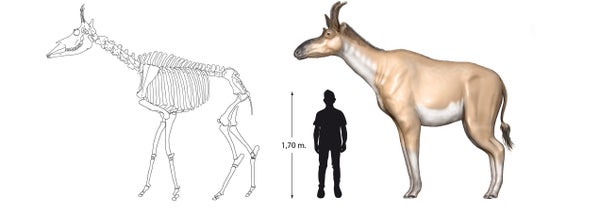
Known from a skull and partial skeleton found in the roughly 9 million year old rock of Spain, the new species is called Decennatherium rex. This was a big beast. Even though this ancient giraffe didn't have a particularly long neck, paleontologist María Ríos and colleagues reconstruct D. rex as over six feet high at the shoulder, carrying its head high enough that it could easily look down on you.
But what makes D. rex so special isn't its size, but its relationship to other fossil giraffes. Ríos and coauthors found that this hefty herbivore is a branch on the giraffe family tree near the origin of two major extinct subgroups - the sivatheres and the samotheres. These were stocky giraffes with four ossicones, some of which looked like giraffes trying to do an impression of the moose. And given that D. rex extends the range of these groups back to about 9 million years ago, Ríos and colleagues point out, it helps make this broader family of sivatheres and samotheres a long-lived and successful family, despite presently being extinct. Not bad for a ruminant that's been dead since the Miocene.

The skeleton of Decennatherium rex. Credit: Ríos et al 2017
On supporting science journalism
If you're enjoying this article, consider supporting our award-winning journalism by subscribing. By purchasing a subscription you are helping to ensure the future of impactful stories about the discoveries and ideas shaping our world today.
Fossil Facts
Name: Decennatherium rex
Meaning: Decennatherium is a previously-established genus of giraffid, and the new species name rex is meant to signify that this large animal was the king of the Miocene Iberian giraffids.
Age: Miocene, about 9 million years old.
Where in the world?: Cerro de los Batallones, Spain.
What sort of organism?: A giraffid.
How much of the organism’s is known?: A skull and partial skeleton.
References:
Ríos, M., Sánchez, I., Morales, J. 2017. A new giraffid (Mammalia, Ruminantia, Pecora) from the late Miocene of Spain, and the evolution of the sivathere-samothere lineage. PLOS ONE. doi: 10.1371/journal.pone.0185378
Previous Paleo Profiles:
The Light-Footed Lizard The Maoming Cat Knight’s Egyptian Bat The La Luna Snake The Rio do Rasto Tooth Bob Weir's Otter Egypt's Canine Beast The Vastan Mine Tapir Pangu's Wing The Dawn Megamouth The Genga Lizard The Micro Lion The Mystery Titanosaur The Echo Hunter The Lo Hueco Titan The Three-Branched Cicada The Monster of Minden The Pig-Footed Bandicoot Hayden's Rattlesnake Demon The Evasive Ostrich Seer The Paradoxical Mega Shark The Tiny Beardogs The Armored Fish King North America's Pangolin The Invisible-Tusked Elephant The Mud Dragon The Spike-Toothed Salmon The Dream Coast Crocodile Buriol's Robber Ozimek's Flyer The Northern Naustoceratopsian The High Arctic Flyer The Tomatillo From the End of the World The Short-Faced Hyena The Mighty Traveler from Egg Mountain Keilhau's Ichthyosaur Mexico's Ancient Horned Face Mauricio Fernández's Plesiosaur New Zealand's Giant Dawn Penguin The Orange Sea Lion Mongolia's Ginkgo Cousin The Geni River Frog Isabel Berry's Dinosaur The Whale Caiman The Moab Lizard Yang Zhongjian's Lizard The Little Anubis The Shuangbai Lizard The Wyvern Dinosaur The "Need Helmet" Dinosaur The Jianianhua Dragon The Liaoning Hunter The Dalian Lizard Crompton's Aleodon Jenkins' Amphibian Serpent From the Chinle The Large Ancestor Lizard The Crown Tooth Currie's Alberta Hunter The Elephant Bird Mimic The Crested Thief The Hiding Hunter The Horned Lizard The Silk Bird The Sieve-Toothed Plesiosaur The Defenseless Snout Burian's Lizard The Small Whaitsiid The Beautiful Bird The Fierce Cat The Older One From Melksham