
This article was published in Scientific American’s former blog network and reflects the views of the author, not necessarily those of Scientific American
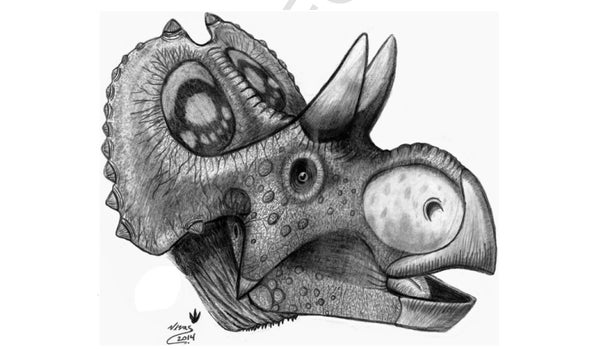
Last April, in my final post for National Geographic, I wrote about a new, as-yet-unnamed horned dinosaur found in Mexico. I thought it was the perfect foil for a send-off, highlighting how we truly are in the golden age of dinosaur discovery. Now, less than a year after that paper by Hector Rivera-Sylva and coauthors was published, that dinosaur has a name.
The horned dinosaur has been dubbed Yehuecauhceratops mudei. It's one of several mysterious species uncovered across northern Mexico in the last decade, and its timing really couldn't be better. Yehuecauhceratops, Rivera-Sylva and colleagues write, is a close relative of Nasutoceratops from Utah - itself only named in 2013 - and joins a growing family of these long-horned, deep-snouted dinosaurs that stretched from Alberta to Coahuila.
More and more, it seems that western North America saw an explosion of horned dinosaur species during the Late Cretaceous. This fits a broader pattern of dinosaur evolution at the time. If you were to survey the dinosaur fauna spread from Alaska to Mexico between 80 and 70 million years ago, you'd see a changing roster of horned dinosaurs, tyrannosaurs, hadrosaurs, ankylosaurs, and more in their own little geographic pockets. It'd be perfect for filling out your dinosaurian life list. But the question is why.
Isolation is key to this kind of evolutionary divergence. Something was separating populations of dinosaurs, allowing them to evolve into dramatically different forms in various places throughout western North America. Perhaps there were geographic barriers, as stark as an impassible floodplain, or maybe the particular diets of dinosaurs kept them pinned to limited ranges. No one knows yet. But every new species helps outline this grand evolutionary pattern, and Mexico is increasingly adding to the record. As Rivera-Sylva and coauthors sign off their paper, "Although the ceratopsian material known from Northern Mexico is currently rare and mostly fragmented, there is an evident potential to discover more and better preserved specimens in the near future." There are more horned faces we have yet to meet.

A map of Mexican ceratopsids. Credit: Rivera-Sylva et al. 2017
Fossil Facts
On supporting science journalism
If you're enjoying this article, consider supporting our award-winning journalism by subscribing. By purchasing a subscription you are helping to ensure the future of impactful stories about the discoveries and ideas shaping our world today.
Name: Yehuecauhceratops mudei
Meaning: Yehuecauhceratops is a combination of the Nahuatl word for ancient and the Greek word for horned face, while mudei honors the Museo del Desierto in Coahuila, Mexico.
Age: Cretaceous, around 74 million years ago.
Where in the world?: La Salada, Mexico.
What sort of critter?: A horned dinosaur related to Nasutoceratops.
Size: About 10 feet long.
How much of the organism’s body is known?: A partial skull, left scapula, left femur, parts of the hips, a vertebra, ribs, and fragments.
Reference:
Rivera-Sylva, H., Frey, E., Stinnesbeck, W., Guzmán-Gutiérrez, J., González-González, A. 2017. Mexican ceratopsids: Considerations on their diversity and biogeography. Journal of South American Earth Sciences. doi: 10.1016/j.jsames.2017.01.008
Previous Paleo Profiles:
The Light-Footed Lizard The Maoming Cat Knight’s Egyptian Bat The La Luna Snake The Rio do Rasto Tooth Bob Weir's Otter Egypt's Canine Beast The Vastan Mine Tapir Pangu's Wing The Dawn Megamouth The Genga Lizard The Micro Lion The Mystery Titanosaur The Echo Hunter The Lo Hueco Titan The Three-Branched Cicada The Monster of Minden The Pig-Footed Bandicoot Hayden's Rattlesnake Demon The Evasive Ostrich Seer The Paradoxical Mega Shark The Tiny Beardogs The Armored Fish King North America's Pangolin The Invisible-Tusked Elephant The Mud Dragon The Spike-Toothed Salmon The Dream Coast Crocodile Buriol's Robber Ozimek's Flyer The Northern Naustoceratopsian The High Arctic Flyer The Tomatillo From the End of the World The Short-Faced Hyena The Mighty Traveler from Egg Mountain Keilhau's Ichthyosaur
