
This article was published in Scientific American’s former blog network and reflects the views of the author, not necessarily those of Scientific American
Ginkgoes are supposed to be living fossils, little changed from the time they started to grow over 270 million years ago. It's easy to look at them that way when there's only one living species, allowing us to draw a straight line back through the fossil record. But ginkgoes didn't sprout out of nowhere. They're as much as part of the tree of life as anything else, and had unusual fossil relatives of their own. Some new fossils from the Cretaceous strata of Mongolia help drive home the point.
For years, paleobotanists have been finding enigmatic, poorly-preserved plant fossils from the Cretaceous rock of Mongolia. No one could tell what they were. But hundreds of new specimens from the Tevshiin Govi coal mine have brought these scraps into focus as a new species of a previously-named genus called Umaltolepis. The full name of the new species, revealed by paleontologist Fabiany Herrera and colleagues, is Umaltolepis mongoliensis.
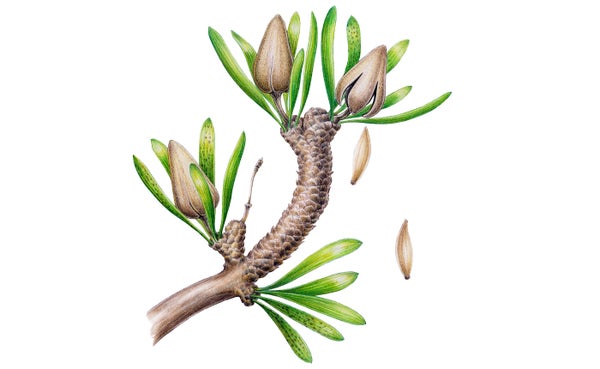
The various plant pieces reveal a plant both strange and familiar. The leaves and steams of Umaltolepis mongoliensis are similar to those of today's ginkgo, but the plant's seeds are small, winged structures very different from the fleshy equivalents of Ginkgo biloba. It's a distant cousin of the ginkgo you might see growing up from a city sidewalk, and this, Herrera and colleagues write, highlights a wider evolutionary view.
Today's ginkgo trees may be relicts, Herrera and coauthors write, but it wasn't always a singular plant. It's a whisper of ancient bloom of species that was lost long ago, "the last survivor of a once highly-diverse group of extinct plants." There are stranger leaves pressed into the ginkgo family album than we ever knew before.

The fossil shoots of Umaltolepis mongoliensis. Credit: Fabiany Herrera & Patrick Herendeen
Fossil Facts
On supporting science journalism
If you're enjoying this article, consider supporting our award-winning journalism by subscribing. By purchasing a subscription you are helping to ensure the future of impactful stories about the discoveries and ideas shaping our world today.
Name: Umaltolepis mongoliensis
Meaning: The species name mongoliensis is a reference to where the fossils were found.
Age: Cretaceous, over 100 million years ago.
Where in the world?: Tevshiin Govi coal mine, Mongolia.
What sort of organism?: A seed plant related to today's ginkgo.
How much of the organism’s is known?: Various parts, including seed-bearing structures and shoots.
Reference:
Herrera, F., Shi, G., Ichinnorov, N., Takahashi, M., Bugdaeva, E., Herendeen, P., Crane, P. 2017. The presumed ginkgophyte Umaltopelpis has seed-bearing structures resembling those of Peltaspermales and Umkomasiales. PNAS. doi: 10.1073/pnas.1621409114
Previous Paleo Profiles:
The Light-Footed Lizard The Maoming Cat Knight’s Egyptian Bat The La Luna Snake The Rio do Rasto Tooth Bob Weir's Otter Egypt's Canine Beast The Vastan Mine Tapir Pangu's Wing The Dawn Megamouth The Genga Lizard The Micro Lion The Mystery Titanosaur The Echo Hunter The Lo Hueco Titan The Three-Branched Cicada The Monster of Minden The Pig-Footed Bandicoot Hayden's Rattlesnake Demon The Evasive Ostrich Seer The Paradoxical Mega Shark The Tiny Beardogs The Armored Fish King North America's Pangolin The Invisible-Tusked Elephant The Mud Dragon The Spike-Toothed Salmon The Dream Coast Crocodile Buriol's Robber Ozimek's Flyer The Northern Naustoceratopsian The High Arctic Flyer The Tomatillo From the End of the World The Short-Faced Hyena The Mighty Traveler from Egg Mountain Keilhau's Ichthyosaur Mexico's Ancient Horned Face Mauricio Fernández's Plesiosaur New Zealand's Giant Dawn Penguin The Orange Sea Lion
