
This article was published in Scientific American’s former blog network and reflects the views of the author, not necessarily those of Scientific American
In the Who's Who of the Mesozoic world, pterosaurs are often referred to as the flying reptiles. No scene from the Age of Reptiles is complete without at least one of them dipping their leathery wings off in the distance. But pterosaurs weren't the only reptiles to swoop through the air during this time. A newly-named species from the Triassic rock of Poland is a reminder that other reptiles took to the air in their own ways.
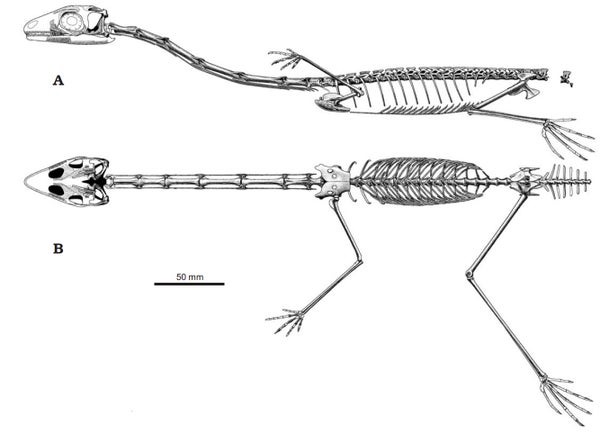
Paleontologists Jerzy Dzik and Tomasz Sulej have named the little reptile Ozimek volans. There's no modern equivalent for this 237-228 million year old critter. The known skeletons and elements recovered so far come together in the form of a reptile with a long neck, spindly front arms, a shield-like pectoral girdle, and elongated hind limbs that likely supported a membrane which allowed Ozimek to glide.
Ozimek wasn't the only reptile with such an arrangement. Another, related animal called Sharovipteryx had leg wings, too, although the long neck and other aspects of Ozimek anatomy mark Dzik and Sulej's animal as something different. Both, however, appear to be protorosaurs - a group of oddities and enigmas that paleontologists are really just beginning to understand.
Little Ozimek probably wasn't an active flyer, though. The osteology of its hind limbs and hips, Dzik and Sulej point out, would have made flapping impossible. Instead Ozimek was more like a reptilian version of a flying squirrel, making its own way into the air during a time when the distantly-related pterosaurs were starting to flap through the skies.

A partial skeleton of Ozimek, including the skull. Credit: Dzik and Sulej 2016
Fossil Facts
On supporting science journalism
If you're enjoying this article, consider supporting our award-winning journalism by subscribing. By purchasing a subscription you are helping to ensure the future of impactful stories about the discoveries and ideas shaping our world today.
Name: Ozimek volans
Meaning: Ozimek is the name of the town near the place this creature was found, and volans means flying.
Age: Triassic, about 237-228 million years ago.
Where in the world?: Krasiejów, Poland.
What sort of critter?: A protorosaur, or a member of a group of strange reptiles within the larger group called archosauromorphs.
Size: Small, but size not yet estimated.
How much of the creature’s body is known?: Several incomplete skeletons and dozens of isolated skeletal elements.
Reference:
Dzik, J., Sulej, T. 2016. An early Late Triassic long-necked reptile with a bony pectoral shield and gracile appendages. Acta Palaeontologica Polonica. doi: 10.4202/app.00276.2016
Previous Paleo Profiles:
The Light-Footed Lizard The Maoming Cat Knight’s Egyptian Bat The La Luna Snake The Rio do Rasto Tooth Bob Weir's Otter Egypt's Canine Beast The Vastan Mine Tapir Pangu's Wing The Dawn Megamouth The Genga Lizard The Micro Lion The Mystery Titanosaur The Echo Hunter The Lo Hueco Titan The Three-Branched Cicada The Monster of Minden The Pig-Footed Bandicoot Hayden's Rattlesnake Demon The Evasive Ostrich Seer The Paradoxical Mega Shark The Tiny Beardogs The Armored Fish King North America's Pangolin The Invisible-Tusked Elephant The Mud Dragon The Spike-Toothed Salmon The Dream Coast Crocodile Buriol's Robber
