
This article was published in Scientific American’s former blog network and reflects the views of the author, not necessarily those of Scientific American
Pterosaurs may as well have been made of paper. Their bones were so light and delicate that at times even looking at them feels like it might crush them. The discovery of any pterosaur remains, then, is at least a minor cause for celebration, with a snaggletoothed jaw from northeastern China being the latest to make its debut.
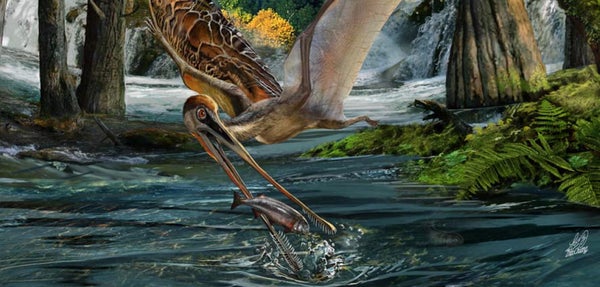
The nearly-complete jaws, found in the 120-million-year-old rock of the Jiufotang Formation, have been named as a new pterosaur by paleontologist Lü Junchang and colleagues. What the entire animal looked like isn't yet known - so far, there's only a jaw - but the researchers argue that the long jaws fitted with 36 curved teeth represents something not seen before. They've named the animal Pangupterus liui.
So what did Pangupterus snatch up with those teeth? That's difficult to say. Gut contents, fossil feces called coprolites, and similar lines of evidence are what paleontologists rely on to determine ancient diets. The authors of the new paper propose a menu of fish - a fitting diet for an animal with slender, piercing teeth - but we'll have to wait on the fossil record for confirmation. Hopefully there's a Pangupterus fossil out there with its last meal intact.

The lower jaw of Pangupterus. Credit: Lü et al., 2016
On supporting science journalism
If you're enjoying this article, consider supporting our award-winning journalism by subscribing. By purchasing a subscription you are helping to ensure the future of impactful stories about the discoveries and ideas shaping our world today.
Fossil Facts
Name: Pangupterus liui
Meaning: Pangupterus is a combination of Pangu, the creator of the universe in some Chinese myths, and the Greek word for wing. The species name liui refers to Jun Liu, who made the specimen available for study.
Age: Cretaceous, around 120 million years old.
Where in the world?: Liaoning Province, northeastern China.
What sort of critter?: A pterosaur.
Size: Not estimated.
How much of the creature’s body is known?: The lower jaws.
Reference:
Lü, J., Cunyu, L., Lijun, P., Caizhi, S. 2016. A new pterodactyloid pterosaur from the Early Cretaceous of the western part of Liaoning Province, northeastern China. Acta Geologica Sinica. doi:
Previous Paleo Profiles:
The Light-Footed Lizard The Maoming Cat Knight’s Egyptian Bat The La Luna Snake The Rio do Rasto Tooth Bob Weir's Otter Egypt's Canine Beast The Vastan Mine Tapir
