
This article was published in Scientific American’s former blog network and reflects the views of the author, not necessarily those of Scientific American
The story of dinosaurs is often told through tooth and bone. Those are the sturdiest parts of a skeleton, and, more often than not, the only parts of their bodies vouchsafed in the stone for our inspection. But they were far more than that, of course. Look at a magpie, robin, or any other living dinosaur and it's easy to see how soft tissues - organs, muscle, feathers, and more - can build an entirely different appearance than what we expect from bones alone. So when we get a petrified view of the outer appearance of extinct species, it's a cause for celebration.
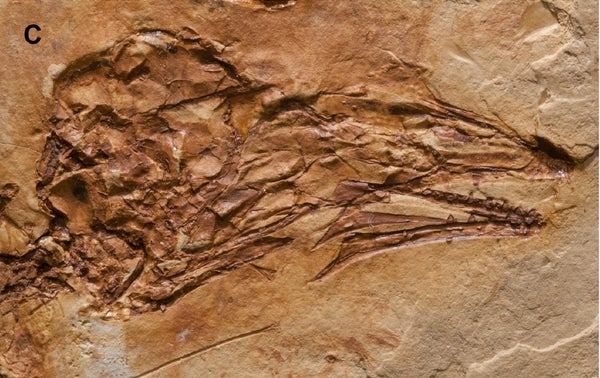
The latest exquisitely-preserved dinosaur to flutter onto the scene is a 125 million year old bird found in Inner Mongolia, China. Paleontologist Di Liu and colleagues have named it Junornis - the beautiful bird - and the fossil lives up to the name. Surrounding the nearly-complete skeleton are remnants of the early bird's feathers, from its wings to the trailing streamers of its tail.
This does more than give us a more refined view of what Junornis would have looked like in life, though. Upon analyzing the aerodynamic capabilities of the bird, Liu and coauthors propose that this Cretaceous flapper was capable of bounding flight - flapping to rise and then folding the wings in to dip, repeating the cycle just in the way small songbirds do today. So when you look at a little chickadee or sparrow flapping and dipping and flapping again through the air, you're seeing something birds have been practicing for about 125 million years.

The skeleton of Junornis. Credit: Liu et al 2017
Fossil Facts
On supporting science journalism
If you're enjoying this article, consider supporting our award-winning journalism by subscribing. By purchasing a subscription you are helping to ensure the future of impactful stories about the discoveries and ideas shaping our world today.
Name: Junornis houi
Meaning: Junornis means "beautiful bird", and the species name houi honors paleontologist Hou Lianhai.
Age: Cretaceous, about 126 million years ago.
Where in the world?: Inner Mongolia, China.
What sort of organism?: A bird belonging to an extinct group called enantiornithines.
How much of the organism’s is known?: A nearly complete, articulated skeleton.
References:
Liu, D., Chiappe, L., Serrano, F., Habib, M., Zhang, Y., Meng, Q. 2017. Flight aerodynamics in enantiornithines: information from a new Chinese Early Cretaceous bird. PLOS ONE. doi: 10.1371/journal.pone.0184637
Previous Paleo Profiles:
The Light-Footed Lizard The Maoming Cat Knight’s Egyptian Bat The La Luna Snake The Rio do Rasto Tooth Bob Weir's Otter Egypt's Canine Beast The Vastan Mine Tapir Pangu's Wing The Dawn Megamouth The Genga Lizard The Micro Lion The Mystery Titanosaur The Echo Hunter The Lo Hueco Titan The Three-Branched Cicada The Monster of Minden The Pig-Footed Bandicoot Hayden's Rattlesnake Demon The Evasive Ostrich Seer The Paradoxical Mega Shark The Tiny Beardogs The Armored Fish King North America's Pangolin The Invisible-Tusked Elephant The Mud Dragon The Spike-Toothed Salmon The Dream Coast Crocodile Buriol's Robber Ozimek's Flyer The Northern Naustoceratopsian The High Arctic Flyer The Tomatillo From the End of the World The Short-Faced Hyena The Mighty Traveler from Egg Mountain Keilhau's Ichthyosaur Mexico's Ancient Horned Face Mauricio Fernández's Plesiosaur New Zealand's Giant Dawn Penguin The Orange Sea Lion Mongolia's Ginkgo Cousin The Geni River Frog Isabel Berry's Dinosaur The Whale Caiman The Moab Lizard Yang Zhongjian's Lizard The Little Anubis The Shuangbai Lizard The Wyvern Dinosaur The "Need Helmet" Dinosaur The Jianianhua Dragon The Liaoning Hunter The Dalian Lizard Crompton's Aleodon Jenkins' Amphibian Serpent From the Chinle The Large Ancestor Lizard The Crown Tooth Currie's Alberta Hunter The Elephant Bird Mimic The Crested Thief The Hiding Hunter The Horned Lizard The Silk Bird The Sieve-Toothed Plesiosaur The Defenseless Snout Burian's Lizard The Small Whaitsiid
