
This article was published in Scientific American’s former blog network and reflects the views of the author, not necessarily those of Scientific American
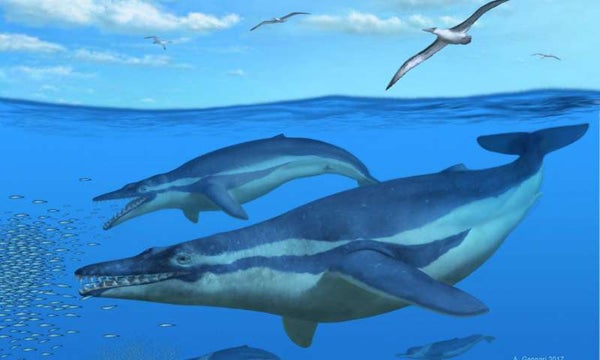
Baleen whales used to have teeth. Paleontologists have known this for decades now, pulling one grinning mysticete after another from strata all over the world. But when did the ancestors of today's minkes and humpbacks make the switch from chomping their food to straining the seas? A new fossil whale found in the 30 million year old rock of South Carolina offers some new clues.
Up to now, there have been two competing hypotheses for how filter feeding evolved among the mysticete whales. One line of argument suggested that ancestral baleen whales were suction feeders and that this led to the loss of teeth and the subsequent evolution of baleen. The other was that whales started filter feeding before they lost their teeth, perhaps even using their dentition and baleen in tandem before the switch. The new evidence from Coronodon havensteini, described by paleontologist Jonathan Geisler and colleagues, supports the second hypothesis.
Even though Coronodon is only known from a skull, that fossil reveals a mammal that mixed the features of earlier, more predaceous whales and the baleen whales that would follow. Most important of all are its teeth. The whale's front teeth were suited to nabbing slippery prey, much like those of its ancestors, but Gesiler and coauthors found that the molars of Coronodon formed slots that could have strained small morsels out of the water. This was filter feeding before baleen.
.jpg?w=1350)
The skull and teeth of Coronodon (with the early whale Zygorhiza included for comparison at C). Credit: Geisler et al 2017
Fossil Facts
On supporting science journalism
If you're enjoying this article, consider supporting our award-winning journalism by subscribing. By purchasing a subscription you are helping to ensure the future of impactful stories about the discoveries and ideas shaping our world today.
Name: Coronodon havensteini
Meaning: Coronodon means "crown tooth", while havensteini honors the fossil's discoverer Mark Havenstein.
Age: Oligocene, about 30 million years old.
Where in the world?: Berkeley County, South Carolina.
What sort of organism?: A cetacean related to today's baleen whales.
How much of the organism’s is known?: A nearly-complete skull.
Reference:
Geisler, J., Boessenecker, R., Brown, M., Beatty, B. 2017. The origin of filter feeding in whales. Current Biology. doi: 10.1016/j.cub.2017.06.003
Previous Paleo Profiles:
The Light-Footed Lizard The Maoming Cat Knight’s Egyptian Bat The La Luna Snake The Rio do Rasto Tooth Bob Weir's Otter Egypt's Canine Beast The Vastan Mine Tapir Pangu's Wing The Dawn Megamouth The Genga Lizard The Micro Lion The Mystery Titanosaur The Echo Hunter The Lo Hueco Titan The Three-Branched Cicada The Monster of Minden The Pig-Footed Bandicoot Hayden's Rattlesnake Demon The Evasive Ostrich Seer The Paradoxical Mega Shark The Tiny Beardogs The Armored Fish King North America's Pangolin The Invisible-Tusked Elephant The Mud Dragon The Spike-Toothed Salmon The Dream Coast Crocodile Buriol's Robber Ozimek's Flyer The Northern Naustoceratopsian The High Arctic Flyer The Tomatillo From the End of the World The Short-Faced Hyena The Mighty Traveler from Egg Mountain Keilhau's Ichthyosaur Mexico's Ancient Horned Face Mauricio Fernández's Plesiosaur New Zealand's Giant Dawn Penguin The Orange Sea Lion Mongolia's Ginkgo Cousin The Geni River Frog Isabel Berry's Dinosaur The Whale Caiman The Moab Lizard Yang Zhongjian's Lizard The Little Anubis The Shuangbai Lizard The Wyvern Dinosaur The "Need Helmet" Dinosaur The Jianianhua Dragon The Liaoning Hunter The Dalian Lizard Crompton's Aleodon Jenkins' Amphibian Serpent From the Chinle The Large Ancestor Lizard
