
This article was published in Scientific American’s former blog network and reflects the views of the author, not necessarily those of Scientific American
Now this is getting ridiculous.
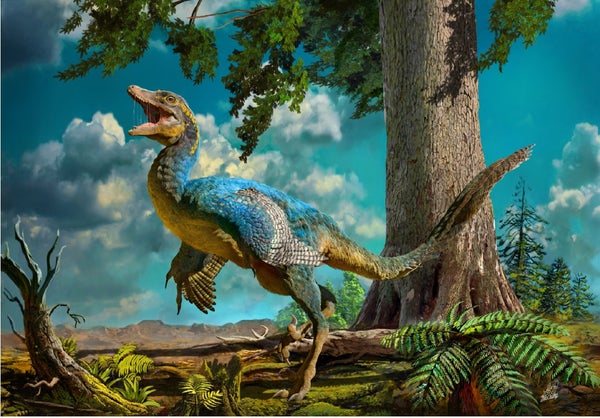
Last week I wrote about how 2017 has seen an entire flock of small, feathery dinosaurs come out of China. Now, hot on the tufted heels of Liaoningvenator comes a related dinosaur who was also skittering around ancient Liaoning Province around 125 million years ago.
The dinosaur, named Daliansaurus liaoningensis by paleontologist Shen Caizhi and colleagues, is a delicate little thing curled up in a piece of Early Cretaceous stone. Whereas the skeleton of the related Liaoningvenator is curled forward, however, Daliansaurus is in the more typical dinosaur death pose with its head thrown back and tail turned upwards. More important for arranging evolutionary trees of China's little troodontid relatives, Daliansaurus seems to be distinct from its relatives on the basis of various skeletal traits - including an extra large claw on its fourth toe.
The announcement of still another troodontid from Liaoning, China only serves to highlight a growing conundrum.
As the authors themselves state, it's possible that paleontologists have inadvertently named the same species more than once - mistaking variations between individuals or differences in age as signs of different species. Then again, Shen and colleagues argue, it may be that these dinosaurs were undergoing an evolutionary radiation within a restricted geographic space. Maybe they followed each other in time, or somehow divvied up habitats by going after different resources. Given that the flow of dinosaurs from this part of China shows no sign of stopping, the mystery will only intensify.
On supporting science journalism
If you're enjoying this article, consider supporting our award-winning journalism by subscribing. By purchasing a subscription you are helping to ensure the future of impactful stories about the discoveries and ideas shaping our world today.

The skeleton of Daliansaurus. Credit: Shen et al 2017
Fossil Facts
Name: Daliansaurus liaoningensis
Meaning: Daliansaurus means "Dalian lizard" in reference to the town, and liaoningensis is after the Chinese province where the fossil was found.
Age: Cretaceous, about 125 million years ago.
Where in the world?: Liaoning, China.
What sort of organism?: A troodontid dinosaur.
How much of the organism’s is known?: A nearly-complete, articulated skeleton.
Reference:
Shen, C., Lü, J., Liu, S., Kundrát, M., Brusatte, S., Gao, H. 2017. A new troodontid dinosaur from the Lower Cretaceous Yixian Formation of Liaoning Province, China. Acta Geologica Sinica. 91 (3): 763-780
Previous Paleo Profiles:
The Light-Footed Lizard The Maoming Cat Knight’s Egyptian Bat The La Luna Snake The Rio do Rasto Tooth Bob Weir's Otter Egypt's Canine Beast The Vastan Mine Tapir Pangu's Wing The Dawn Megamouth The Genga Lizard The Micro Lion The Mystery Titanosaur The Echo Hunter The Lo Hueco Titan The Three-Branched Cicada The Monster of Minden The Pig-Footed Bandicoot Hayden's Rattlesnake Demon The Evasive Ostrich Seer The Paradoxical Mega Shark The Tiny Beardogs The Armored Fish King North America's Pangolin The Invisible-Tusked Elephant The Mud Dragon The Spike-Toothed Salmon The Dream Coast Crocodile Buriol's Robber Ozimek's Flyer The Northern Naustoceratopsian The High Arctic Flyer The Tomatillo From the End of the World The Short-Faced Hyena The Mighty Traveler from Egg Mountain Keilhau's Ichthyosaur Mexico's Ancient Horned Face Mauricio Fernández's Plesiosaur New Zealand's Giant Dawn Penguin The Orange Sea Lion Mongolia's Ginkgo Cousin The Geni River Frog Isabel Berry's Dinosaur The Whale Caiman The Moab Lizard Yang Zhongjian's Lizard The Little Anubis The Shuangbai Lizard The Wyvern Dinosaur The "Need Helmet" Dinosaur The Jianianhua Dragon The Liaoning Hunter
