
This article was published in Scientific American’s former blog network and reflects the views of the author, not necessarily those of Scientific American
If the saw-tusked elephants are known for anything, it's their tusks. It's right there in the title. How strange, then, that the latest addition to the family is missing a set of modified incisors that are ubiquitous among its relatives.
Many new fossil species come to us as fragments. Parts of skeleton or isolated teeth that represent something new, but not completely known. Not so with Aphanobelodon zhaoi. This 14 million year old elephant is represented by a set of near-complete skeletons from baby to adult, providing an unusually-detailed look at this extinct pachyderm.
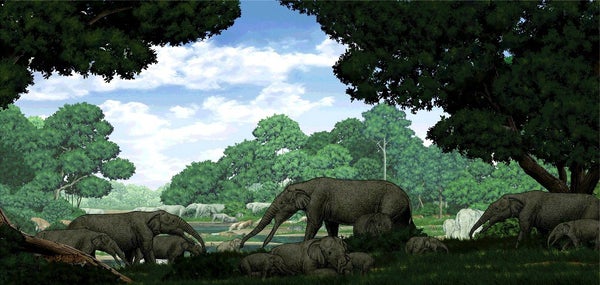
Aphanobelodon means "invisible front tooth." That's because these elephants totally lacked upper tusks. They still had the long, shovel shaped mouths common to their family, but they're unique in missing the distinctive upper ivory of beasts such as Platybelodon.
Why Aphanobelodon dropped the upper tusks isn't clear. Whatever the reason, though, it seems that the change didn't alter the elephant's feeding style. Little scratches on the teeth of Aphanobelodon suggest this beast was a browser that fed on a variety of vegetation much like its cousin Platybelodon. Just imagine a herd of these ancient elephants lumbering through the forests, grasping branches with their trunks and slicing them up into more manageable pieces with their strange lower tusks before stuffing the salad into their mouths.

Skulls of Aphanobelodon. Credit: Wang et al. 2016
Fossil Facts
On supporting science journalism
If you're enjoying this article, consider supporting our award-winning journalism by subscribing. By purchasing a subscription you are helping to ensure the future of impactful stories about the discoveries and ideas shaping our world today.
Name: Aphanobelodon zhaoi
Meaning: Aphanobelodon means "invisible front tooth", referring to the lack of upper tusks, and zhaoi is a tribute to excavator Rong Zhao.
Age: Miocene, about 14 million years old.
Where in the world?: Maerzuizigou Quarry, northern China.
What sort of critter?: An elephant related to other saw-tusked species.
Size: An adult male Aphanobelodon weighed over two tons while an adult female weighed just under a ton and a half.
How much of the creature’s body is known?: Skeletons representing multiple individuals of different ages, some of which are described as "completely preserved."
Reference:
Wang, S., Deng, T., Ye, J., He, W., Chen, S. 2016. Morphological and ecological diversity of Ambelodontidae (Proboscidea, Mammalia) reveal by a Miocene fossil accumulation of an upper-tuskless proboscidean. Journal of Systematic Palaeontology. doi: 10.1080/14772019.2016.1208687
Previous Paleo Profiles:
The Light-Footed Lizard The Maoming Cat Knight’s Egyptian Bat The La Luna Snake The Rio do Rasto Tooth Bob Weir's Otter Egypt's Canine Beast The Vastan Mine Tapir Pangu's Wing The Dawn Megamouth The Genga Lizard The Micro Lion The Mystery Titanosaur The Echo Hunter The Lo Hueco Titan The Three-Branched Cicada The Monster of Minden The Pig-Footed Bandicoot Hayden's Rattlesnake Demon The Evasive Ostrich Seer The Paradoxical Mega Shark The Tiny Beardogs The Armored Fish King North America's Pangolin
