
This article was published in Scientific American’s former blog network and reflects the views of the author, not necessarily those of Scientific American
When the first known skeleton of Archaeopteryx was uncovered in 1861, no one had seen such a creature before. The long bony tail and claws were all reptile, but the feathers left no question that the animal was a bird. This creature was a connecting point between saurians and birds, but where to draw the line? Paleontologists debated the issue for decades afterward, trying to fill the anatomical gaps on either side of the urvogel.
Over a century and a half later, Archaeopteryx doesn't look so special. Dozens of finds from around the world have confirmed that birds are just another lineage of dinosaur, and, had the amazing fossil deposits of China been discovered earlier, we might have labeled different creatures as the beginning of the bird branch of the dinosaur family tree. Another such fluffy creature has just been described by paleontologist Xu Xing and colleagues, and they have given it the name Jianianhualong tengi.
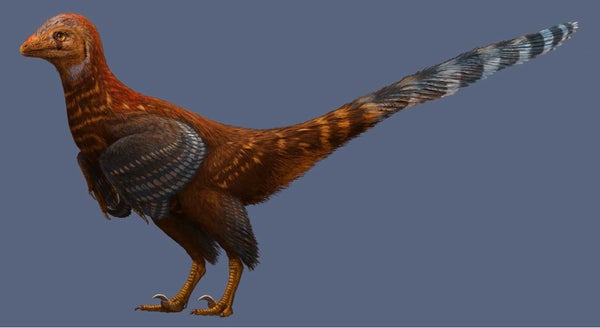
Almost everything about Jianianhualong is reminiscent of Archaeopteryx. The skeleton is preserved in a contorted death pose - the spitting image of the "Solnhofen Specimen" - and includes remnants of long feathers along the limbs as well as "frond-like tail feathering." Not that Jianianhualong was especially close to the first bird. The researchers found other recently-named dinosaurs were closer to Archaeopteryx. Rather, they write, the anatomy of plumage of Jianianhualong indicate that the dinosaur's feather anatomy probably represents the common condition for dinosaurs related to the lineage from which birds arose.
No dinosaur stands alone. What a particular species or skeleton tells us always has to be put in the context of others. In the case of Jianianhualong, the dinosaur's feathering gives paleontologists a better idea of what the ancestral plumage pattern looked like.
It's unlikely that we're ever going to find a direct line of descent between non-avian and avian dinosaurs. The fossil record is too capricious, and we're always dealing with animals with transitional features that are representative of those major changes in life. What Jianianhualong is offer a little more confirmation that the Archaeopteryx-style array of feathers was widespread among dinosaurs related to the origin of birds, and may offer us some critical clues about how the terrible lizards took to the air.

The skeleton of Jianianhualong. Credit: Xu et al 2017
On supporting science journalism
If you're enjoying this article, consider supporting our award-winning journalism by subscribing. By purchasing a subscription you are helping to ensure the future of impactful stories about the discoveries and ideas shaping our world today.
Fossil Facts
Name: Jianianhualong tengi
Meaning: Jianianhualong is a combination of the name of a Chinese company and the word for dragon. The species name is after Fangfang Teng, "who secured the specimen for study."
Age: Cretaceous, about 125 million years ago.
Where in the world?: Liaoning, China.
What sort of organism?: A troodontid dinosaur.
How much of the organism’s is known?: A nearly-complete skeleton with feather fossils.
Reference:
Xu, X., Currie, P., Pittman, M., Xing, L., Meng, Q., Lü, J., Hu, D., Yu, C. 2017. Mosaic evolution in an asymmetrically feathered troodontid dinosaur with transitional features. Nature Communications. doi: ncomms14972
Previous Paleo Profiles:
The Light-Footed Lizard The Maoming Cat Knight’s Egyptian Bat The La Luna Snake The Rio do Rasto Tooth Bob Weir's Otter Egypt's Canine Beast The Vastan Mine Tapir Pangu's Wing The Dawn Megamouth The Genga Lizard The Micro Lion The Mystery Titanosaur The Echo Hunter The Lo Hueco Titan The Three-Branched Cicada The Monster of Minden The Pig-Footed Bandicoot Hayden's Rattlesnake Demon The Evasive Ostrich Seer The Paradoxical Mega Shark The Tiny Beardogs The Armored Fish King North America's Pangolin The Invisible-Tusked Elephant The Mud Dragon The Spike-Toothed Salmon The Dream Coast Crocodile Buriol's Robber Ozimek's Flyer The Northern Naustoceratopsian The High Arctic Flyer The Tomatillo From the End of the World The Short-Faced Hyena The Mighty Traveler from Egg Mountain Keilhau's Ichthyosaur Mexico's Ancient Horned Face Mauricio Fernández's Plesiosaur New Zealand's Giant Dawn Penguin The Orange Sea Lion Mongolia's Ginkgo Cousin The Geni River Frog Isabel Berry's Dinosaur The Whale Caiman The Moab Lizard Yang Zhongjian's Lizard The Little Anubis The Shuangbai Lizard The Wyvern Dinosaur The "Need Helmet" Dinosaur
