
This article was published in Scientific American’s former blog network and reflects the views of the author, not necessarily those of Scientific American
It's difficult not to "Aww" at wombats. The herbivorous marsupials look like animate pillows. But now imagine a wombat that fed on flesh rather than grasses and roots. Such beasts really existed in the prehistoric past. These were the marsupial lions.
The first of these cleaver-toothed mammals known to science, Thylacoleo carnifex, was named by anatomist Richard Owen in 1858 from fossils found in Australia. No one could have imaged such a carnivore had ever existed. While the skull was reminiscent of wombats and koalas, the teeth were blade-like slicers used to cut through flesh. And this creature was not a one-off. Several disctinct thylacoleonids lived on Australia from 25 million to 46 thousand years ago, and now paleontologist Anna Gillespie and colleagues have named the smallest one of all.
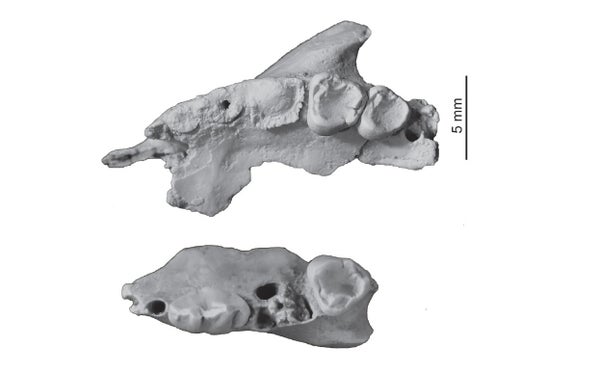
Named Microleo attenboroughi, the 18-million-year-old marsupial is only known from parts of the upper jaws and an isolated molar. Nevertheless, Gillespie and coauthors write, the teeth are distinctive enough to justify establishing the marsupial lion as something new to science. Although, given their size estimate, marsupial kitten might be a better title. Microleo would have only weighed a little more than a pound.
Microleo wasn't the only carnivore of its kind prowling around. In the same place and around the same time there were two other, larger marsupial lions - the leopard-sized Wakaleo and domestic cat-sized Priscileo. This seems to dovetail with a pattern seen among other closely-related marsupial predators, Gillesspie and colleagues propose, hinting that each marsupial lion species had different diets and habits that allowed them to coexist. Given their smaller size Microleo and Priscileo may have spent more time in the trees. Imagine that - a fierce little carnivore scampering along branches after possums and looking adorable doing it.

A family tree of marsupial lions. Credit: Gillespie et al. 2016
Fossil Facts
On supporting science journalism
If you're enjoying this article, consider supporting our award-winning journalism by subscribing. By purchasing a subscription you are helping to ensure the future of impactful stories about the discoveries and ideas shaping our world today.
Name: Microleo attenboroughi
Meaning: Microleo means "tiny lion," while attenboroughi honors natural history TV host David Attenborough.
Age: Miocene, between 18.2 and 17.8 million years old.
Where in the world?: Riversleigh World Heritage Area, Australia.
What sort of critter?: A marsupial mammal related to koalas and wombats.
Size: Estimated at 1.3 pounds, about the size of a domestic kitten.
How much of the creature’s body is known?: A fragmentary palate and an isolated third molar.
Reference:
Gillespie, A., Archer, M., Hand, S. 2016. A tiny new marsupial lion (Marsupialia, Thylacoleonidae) from the early Miocene of Australia. Palaeontologia Electronica. 19.2.26A: 1-26
Previous Paleo Profiles:
The Light-Footed Lizard The Maoming Cat Knight’s Egyptian Bat The La Luna Snake The Rio do Rasto Tooth Bob Weir's Otter Egypt's Canine Beast The Vastan Mine Tapir Pangu's Wing The Dawn Megamouth The Genga Lizard
