
This article was published in Scientific American’s former blog network and reflects the views of the author, not necessarily those of Scientific American
In my last Paleo Profile of 2017 I remarked how last year was positively packed with new species of troodontid dinosaurs. But I could have just as easily said the same about fossil whales. The past year has seen an abundance of ancient cetaceans, including a new fossil dolphin.
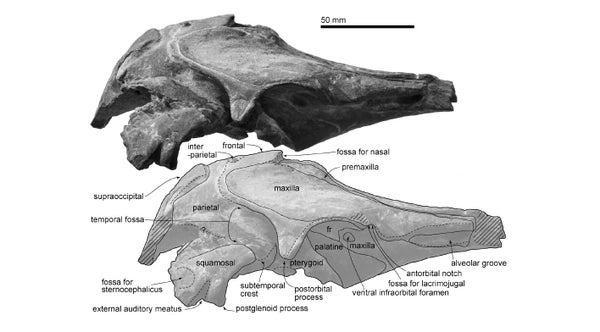
Described by Yoshihiro Tanaka and colleagues, the roughly 25-million-year-old cetacean was found in Santa Elena Province, Ecuador. So far, it's only represented by a partial skull from a juvenile animal. Nevertheless, the fossil is something new - Urkudelphis chawpipacha, a member of a group of dolphins called platanistoids that's only represented by a handful of river dolphin species today.
Exactly how Urkudelphis made its living is as yet unclear. The partial skull is missing some of the critical parts related to hearing and feeding, and, as the paleontologists report, it's unknown whether this dolphin lived in the estuaries of its time or ventured further out to sea. But the fact that Urkudelphis was found in Ecuador makes it stand out. Finds of fossil whales are rare along the equator, and, Tanaka and colleagues conclude, Urkudelphis "is a reminder that Oligocene cetaceans may have ranged widely in tropical waters." There's still more out there to find.
On supporting science journalism
If you're enjoying this article, consider supporting our award-winning journalism by subscribing. By purchasing a subscription you are helping to ensure the future of impactful stories about the discoveries and ideas shaping our world today.
.jpg?w=1350)
The skull of Urkudelphis seen from the top. Credit: Tanaka et al 2017
Name: Urkudelphis chawpipacha
Meaning: Urkudelphis is a combination of Kichwa for mountain and Greek for dolphin. The species name chawpipacha translates to "middle of the world" in reference to Ecuador.
Age: Oligocene, 26-24 million years ago.
Where in the world?: Santa Elena Province, Ecuador.
What sort of organism?: A whale related to today's Indian river dolphins.
How much of the organism’s is known?: A partial skull.
References:
Tanaka, Y., Abella, J., Aguirre-Fernández, G., Gregori, M., Fordyce, R. 2017. A new tropical Oligocene dolphin from Montañita/Olón, Santa Elena, Ecuador. PLOS ONE. doi: 10.1371/journal.pone.0188380
More Paleo Profiles:
The Light-Footed Lizard The Maoming Cat Knight’s Egyptian Bat The La Luna Snake The Rio do Rasto Tooth Bob Weir's Otter Egypt's Canine Beast The Vastan Mine Tapir Pangu's Wing The Dawn Megamouth The Genga Lizard The Micro Lion The Mystery Titanosaur The Echo Hunter The Lo Hueco Titan The Three-Branched Cicada The Monster of Minden The Pig-Footed Bandicoot Hayden's Rattlesnake Demon The Evasive Ostrich Seer The Paradoxical Mega Shark The Tiny Beardogs The Armored Fish King North America's Pangolin The Invisible-Tusked Elephant The Mud Dragon The Spike-Toothed Salmon The Dream Coast Crocodile Buriol's Robber Ozimek's Flyer The Northern Naustoceratopsian The High Arctic Flyer The Tomatillo From the End of the World The Short-Faced Hyena The Mighty Traveler from Egg Mountain Keilhau's Ichthyosaur Mexico's Ancient Horned Face Mauricio Fernández's Plesiosaur New Zealand's Giant Dawn Penguin The Orange Sea Lion Mongolia's Ginkgo Cousin The Geni River Frog Isabel Berry's Dinosaur The Whale Caiman The Moab Lizard Yang Zhongjian's Lizard The Little Anubis The Shuangbai Lizard The Wyvern Dinosaur The "Need Helmet" Dinosaur The Jianianhua Dragon The Liaoning Hunter The Dalian Lizard Crompton's Aleodon Jenkins' Amphibian Serpent From the Chinle The Large Ancestor Lizard The Crown Tooth Currie's Alberta Hunter The Elephant Bird Mimic The Crested Thief The Hiding Hunter The Horned Lizard The Silk Bird The Sieve-Toothed Plesiosaur The Defenseless Snout Burian's Lizard The Small Whaitsiid The Beautiful Bird The Fierce Cat The Older One From Melksham The King of the Miocene Iberian Giraffes Miera's Lizard The Traveling Sloth The Sand Whale Shouten's Marsupial Lion The Rhaetian Lizard
