
This article was published in Scientific American’s former blog network and reflects the views of the author, not necessarily those of Scientific American
Visit the southern California shore and it's hard to miss the pinnipeds. Sea lions and harbor seals are common sights along the beaches and among the waves, carrying on a blubbery legacy that has been going on for tens of millions of years. Shifting and evolving communities of pinnipeds have called the California coast home for over 25 million years, and now paleontologist Jorge Velez-Juarbe has added another species to the list.
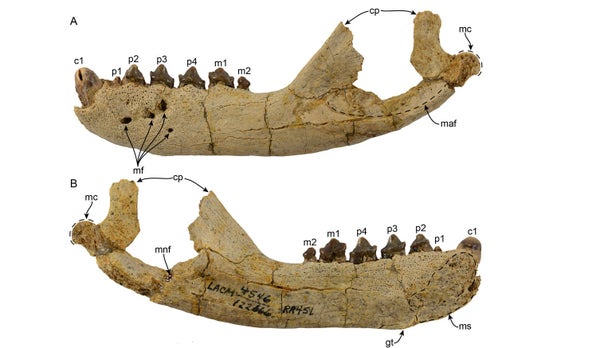
The new pinniped is an eared seal, more closely related to today's sea lions than harbor seals. Velez-Juarbe has dubbed it Eotaria citrica, and this small pinniped swam in waters that covered Orange County around 15 million years ago.
Eotaria wasn't the only prehistoric pinniped around. The same fossil beds have yielded another closely-related species - Eotaria crypta - as well as ancient walrus relatives and oddities like Allodesmus. Not that this grouping was consistent all along the coast. The aggregation at the spot the new Orange County Eotaria were found is similar to that of another famous spot of the same age - Sharktooth Hill - yet Eotaria is missing from the Sharktooth Hill sediments. Perhaps the reason has something to do with differences in the way fossils were preserved in the different spots, Velez-Juarbe writes, or something to do with the environmental preferences of the pinnipeds.
All the same, Eotaria citrica stands out as an early form of eared seal from a time when most pinnipeds were smaller in stature. Looking at the SoCal seals through time, Velez-Juarbe highlights an increase in body size through different pinniped lineages. This dovetails with changes seen among marine birds, mollusks, and whales in the area, hinting that ocean productivity was increasing as the millennia rolled by. Eotaria lived at a time just before that wave.

Pinniped faunas of southern California through time. Credit: Velez-Juarbe 2017
Fossil Facts
On supporting science journalism
If you're enjoying this article, consider supporting our award-winning journalism by subscribing. By purchasing a subscription you are helping to ensure the future of impactful stories about the discoveries and ideas shaping our world today.
Name: Eotaria citrica
Meaning: Eotaria is a genus of early eared seals, and citrica is a nod to California's Orange County where the fossils were found.
Age: Miocene, about 15 million years ago.
Where in the world?: Orange Country, California.
What sort of critter?: An eared seal.
Size: About four and a half feet long.
How much of the organism’s body is known?: A nearly-complete left lower jaw.
Reference:
Velez-Juarbe, J. 2017. Eotaria citrica, sp. nov., a new stem otariid from the "Topanga" formation of Southern California. PeerJ. doi: 10.7717/peerj.3022
Previous Paleo Profiles:
The Light-Footed Lizard The Maoming Cat Knight’s Egyptian Bat The La Luna Snake The Rio do Rasto Tooth Bob Weir's Otter Egypt's Canine Beast The Vastan Mine Tapir Pangu's Wing The Dawn Megamouth The Genga Lizard The Micro Lion The Mystery Titanosaur The Echo Hunter The Lo Hueco Titan The Three-Branched Cicada The Monster of Minden The Pig-Footed Bandicoot Hayden's Rattlesnake Demon The Evasive Ostrich Seer The Paradoxical Mega Shark The Tiny Beardogs The Armored Fish King North America's Pangolin The Invisible-Tusked Elephant The Mud Dragon The Spike-Toothed Salmon The Dream Coast Crocodile Buriol's Robber Ozimek's Flyer The Northern Naustoceratopsian The High Arctic Flyer The Tomatillo From the End of the World The Short-Faced Hyena The Mighty Traveler from Egg Mountain Keilhau's Ichthyosaur Mexico's Ancient Horned Face Mauricio Fernández's Plesiosaur New Zealand's Giant Dawn Penguin
