
This article was published in Scientific American’s former blog network and reflects the views of the author, not necessarily those of Scientific American
Dicynodonts rarely get the credit they deserve. These distant protomammal cousins of ours proliferated in the millions of years before the dinosaurs, munching vegetation with their tusk-flanked beaks, and some of them managed to amble right through the worst mass extinction of all time unscathed. Now paleontologists have added another member to this successful family, although its teeth immediately set it apart from all the tubby tuskers.
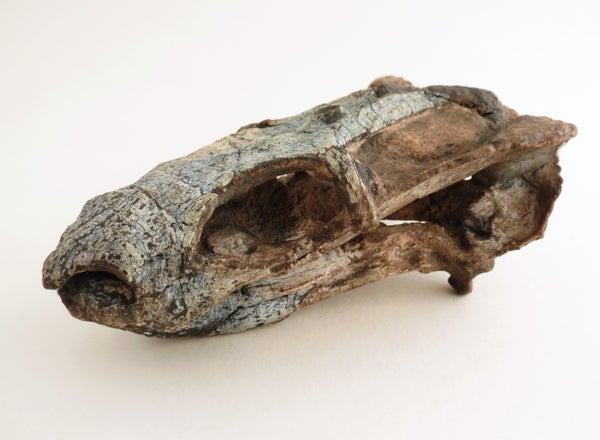
The creature, found in southern Brazil, has been named Rastodon procurvidens by paleontologist Alessandra Boos and colleagues. The species name tells you why Rastodon stands out. Instead of curving down or backward, as in other dicynodonts, the tusks flanking the mouth of Rastodon curve forwards. This isn't an injury or something caused by postmortem squishing of the fossil, the researchers write, but represents a new and enigmatic variation on a common theme.
Rastodon is more than just a Permian oddity, though. Boos and coauthors write that this ancient herbivore belonged to a major dicynodont subgroup called Bidentalia. These animals had no teeth but their tusks, and Rastodon is now the earliest known member of the group. Why the forward-facing tusk trend never caught on, though, will have to wait until more of this herbivore's relatives can be found.

The skull of Rastodon. From Boos et al., 2016.
Fossil Facts
On supporting science journalism
If you're enjoying this article, consider supporting our award-winning journalism by subscribing. By purchasing a subscription you are helping to ensure the future of impactful stories about the discoveries and ideas shaping our world today.
Name: Rastodon procurvidens
Meaning: Rastodon means "Rio do Rasto tooth" after the formation in which the animal was found, and procurvidens references the protomammal's forward-curving tusks.
Age: Permian, around 260 million years old.
Where in the world?: Paraná Basin, Brazil.
What sort of critter?: A protomammal belonging to a group called dicynodonts.
Size: Not estimated, but said to be small for a dicynodont.
How much of the creature’s body is known?: A skull and jaws, along with a skeleton still in rock.
Reference:
Boos, A., Kammerer, C., Schultz, C., Soares, M., Ilha, A. 2016. A new dicynodont (Therapsida: Anomodontia) from the Permian of southern Brazil and its implications for bidentalian origins. PLOS ONE. doi: 10.1371/journal.pone.0155000
Previous Paleo Profiles:
The Light-Footed Lizard The Maoming Cat Knight’s Egyptian Bat The La Luna Snake
For more on Rastodon, see Sarah Gibson's post at PLOS Paleo.
