
This article was published in Scientific American’s former blog network and reflects the views of the author, not necessarily those of Scientific American
In the early days of the Jurassic, carnivorous dinosaurs were getting fancy. Dilophosaurus, Cryolophosaurus, Sinosaurus... all these sharp-toothed representatives of their age bore flashy crests atop their skulls. Now paleontologist Wang Guo-Fu and colleagues have added another to the list - a crested theropod they've named Shuangbaisaurus.
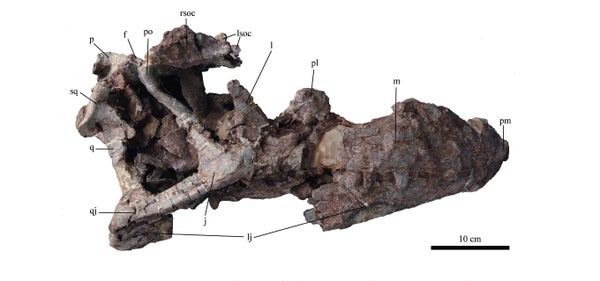
Relatively little of Shuangbaisaurus has come to the surface so far. Wang and coauthors based their description on a partial cranium and lower jaw. Still, the ornamentation of this dinosaur is different from crested forms found elsewhere. The preserved portions of the crests stick out just above the eyes, offering just a hint of what were certainly larger structures in life.
So why were these early theropods so showy? That's still a mystery. Sexual display is a popular answer, but that's difficult to demonstrate in the fossil record. (Especially given that no non-avian dinosaur has been found to show sexual dimorphism, the classic hallmark of sexual selection.) Species recognition is also possible, but is also hard to pick out. And, of course, these explanations are not mutually exclusive and may not touch on the real reasons at all. We'd have to go back to the days of the Early Jurassic and follow Shuangbaisaurus and its relatives around. Still, the crests are a reminder that dinosaurs were living animals that wore striking decorations to communicate with others of their kind. Figuring our what those messages were keeps us going back into the fossil record to see if we might decode them from the bones.

The skull of Shuangbaisaurus from above, showing the distortion of the snout. Credit: Wang et al 2017
On supporting science journalism
If you're enjoying this article, consider supporting our award-winning journalism by subscribing. By purchasing a subscription you are helping to ensure the future of impactful stories about the discoveries and ideas shaping our world today.
Fossil Facts
Name: Shuangbaisaurus anlongbaoensis
Meaning: Shuangbaisaurus means "Shuangbai lizard", in reference to the county where the fossil was found, and anlongbaoensis is a reference to the local town whose name means "dragon-placing fort."
Age: Jurassic, over 175 million years ago.
Where in the world?: Yunnan, China.
What sort of organism?: A theropod dinosaur.
Size: Unknown
How much of the organism’s is known?: A partial skull with a lower jaw.
Reference:
Wang, G., You, H., Pan, S., Wang, T. 2017. A new created theropod dinosaur from the Early Jurassic of Yannan Province, China. Vertebrata PalAsiatica. 55 (2): 177-186
Previous Paleo Profiles:
The Light-Footed Lizard The Maoming Cat Knight’s Egyptian Bat The La Luna Snake The Rio do Rasto Tooth Bob Weir's Otter Egypt's Canine Beast The Vastan Mine Tapir Pangu's Wing The Dawn Megamouth The Genga Lizard The Micro Lion The Mystery Titanosaur The Echo Hunter The Lo Hueco Titan The Three-Branched Cicada The Monster of Minden The Pig-Footed Bandicoot Hayden's Rattlesnake Demon The Evasive Ostrich Seer The Paradoxical Mega Shark The Tiny Beardogs The Armored Fish King North America's Pangolin The Invisible-Tusked Elephant The Mud Dragon The Spike-Toothed Salmon The Dream Coast Crocodile Buriol's Robber Ozimek's Flyer The Northern Naustoceratopsian The High Arctic Flyer The Tomatillo From the End of the World The Short-Faced Hyena The Mighty Traveler from Egg Mountain Keilhau's Ichthyosaur Mexico's Ancient Horned Face Mauricio Fernández's Plesiosaur New Zealand's Giant Dawn Penguin The Orange Sea Lion Mongolia's Ginkgo Cousin The Geni River Frog Isabel Berry's Dinosaur The Whale Caiman The Moab Lizard Yang Zhongjian's Lizard The Little Anubis
