
This article was published in Scientific American’s former blog network and reflects the views of the author, not necessarily those of Scientific American
Learning the fossil lexicon can be challenging. Not every name is as simple or sibilant as Stegosaurus. For example, the whaitsiids. My brain keeps wanting the word to read "what-is-it-ids", which actually wouldn't be far off. These ancient synapsids - or protomammals, if you like - aren't exactly rock stars. All the same, they are cousins of ours and a part of the long evolutionary story that mammals are carrying on today. So it seems only fair to take a moment away from the dinosaurs and other prehistoric celebrities to look at a new little whaitsiid found in South Africa.
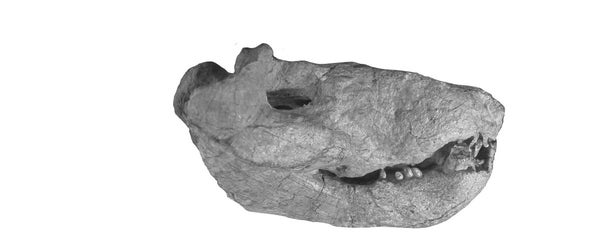
Described by paleontologists Adam Huttenlocker and Roger Smith, the small creature is called Microwhaitsia mendrezi. The 260 million year old skull and isolated snout found so far have a superficially dog-like appearance about them, despite the fact that this animal lived over 200 million years before canines would come on the scene.
What makes Microwhaitsia special, though, is how it and another animal named by Huttenlocker and Smith - called Ophidostoma tatarinovi - have added new context to a murky chapter in protomammal history.
The two protomammals lived around a time when life was changing. Paleontologists known this as the middle-to-late Permian transition, when the abundances and different groups of protomammals changed. So here's where Microwhaitsia comes in.
Not only does Microwhaitsia now stand as the oldest member of its lineage - the whaitsiids - in the southern continent of Gondwana, but its relation to other finds suggests that this group was widespread earlier than previously known. It was part of a rising tide of new forms of protomammals that were replacing previous ones, undergoing a radiation of their own. This pattern follows the long fuse model, Huttenlocker and Smith write, with the little whaitsiids originating alongside more archaic forms of protomammals and eventually outpacing them in evolutionary terms. How this happened is still a mystery, but this little synapsid is a sign of a much bigger change in life's story.

Stereopair images of the Microwhaitsia skull. Credit: Huttenlocker and Smith 2017
On supporting science journalism
If you're enjoying this article, consider supporting our award-winning journalism by subscribing. By purchasing a subscription you are helping to ensure the future of impactful stories about the discoveries and ideas shaping our world today.
Fossil Facts
Name: Microwhaitsia mendrezi
Meaning: Microwhaitsia means "small whaitsiid", referring to a particular group of protomammals, while mendrezi honors paleontologist Christiane Mendrez-Carroll.
Age: Permian, about 260 million years ago.
Where in the world?: Karoo Basin, South Africa.
What sort of organism?: A protomammal called a therocephalian.
How much of the organism’s is known?: A partial skull with jaws and a snout.
References:
Huttenlocker, A., Smith, R. 2017. New whaitsioids (Therapsida: Therocephalia) from the Teeklook Formation of South African and therocephalian diversity during the end-Guadalupian extinction. PeerJ. doi: 10.7717/peerj.3868
Previous Paleo Profiles:
The Light-Footed Lizard The Maoming Cat Knight’s Egyptian Bat The La Luna Snake The Rio do Rasto Tooth Bob Weir's Otter Egypt's Canine Beast The Vastan Mine Tapir Pangu's Wing The Dawn Megamouth The Genga Lizard The Micro Lion The Mystery Titanosaur The Echo Hunter The Lo Hueco Titan The Three-Branched Cicada The Monster of Minden The Pig-Footed Bandicoot Hayden's Rattlesnake Demon The Evasive Ostrich Seer The Paradoxical Mega Shark The Tiny Beardogs The Armored Fish King North America's Pangolin The Invisible-Tusked Elephant The Mud Dragon The Spike-Toothed Salmon The Dream Coast Crocodile Buriol's Robber Ozimek's Flyer The Northern Naustoceratopsian The High Arctic Flyer The Tomatillo From the End of the World The Short-Faced Hyena The Mighty Traveler from Egg Mountain Keilhau's Ichthyosaur Mexico's Ancient Horned Face Mauricio Fernández's Plesiosaur New Zealand's Giant Dawn Penguin The Orange Sea Lion Mongolia's Ginkgo Cousin The Geni River Frog Isabel Berry's Dinosaur The Whale Caiman The Moab Lizard Yang Zhongjian's Lizard The Little Anubis The Shuangbai Lizard The Wyvern Dinosaur The "Need Helmet" Dinosaur The Jianianhua Dragon The Liaoning Hunter The Dalian Lizard Crompton's Aleodon Jenkins' Amphibian Serpent From the Chinle The Large Ancestor Lizard The Crown Tooth Currie's Alberta Hunter The Elephant Bird Mimic The Crested Thief The Hiding Hunter The Horned Lizard The Silk Bird The Sieve-Toothed Plesiosaur The Defenseless Snout Burian's Lizard
