
This article was published in Scientific American’s former blog network and reflects the views of the author, not necessarily those of Scientific American
This was the year of Brood V. It sounds like something out of a horror movie, and, depending on your feelings about cicadas, maybe that's exactly how it felt. From New York to West Virginia, this spring saw innumerable 17-year cicadas emerge and sing their arthropod hearts out. I wonder if dinosaurs had to cope with such sounds, too, as cicadas have a deep history that stretches back into the heart of the Mesozoic.
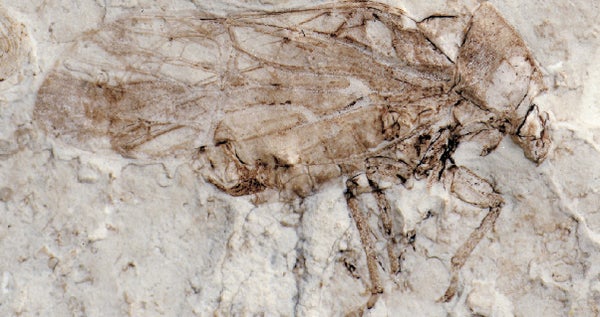
The Jurassic rock of Inner Mongolia, paleontologist Jun Chen and colleagues report, have yielded three new species of prehistoric cicadas. To be fair, these were not exactly like the brightly-colored screechers you might see in your yard. These roughly 164-million-year-old cicadas belonged to a group called the tettigarctids, or hairy cicadas, that were much more common in the past but are very rare today. Chen and coauthors have named them Sanmai kongi, Sanmai mengi, and Sanmai xuni.
Each of the fossilized insects is exceptional, preserved down to the veins on their wings. They're so delicately-preserved, in fact, that Chen and coauthors were able to see that some specimens of S. kongi and S. xuni had peculiar speckles and stripes on their forewings that would have acted as disruptive coloration. In a world where pterosaurs, arboreal mammals, and feathered dinosaurs were all hungrily hopping through the forest, camouflage was key.

The other side of the female Sanmai kongi fossil. Credit: Chen et al. 2016
Fossil Facts
On supporting science journalism
If you're enjoying this article, consider supporting our award-winning journalism by subscribing. By purchasing a subscription you are helping to ensure the future of impactful stories about the discoveries and ideas shaping our world today.
Name: Sanmai kongi
Meaning: Sanmai is Mandarin for "three branches", referring to the M-shaped veins on the insect's wing, while kongi is after Confucius.
Age: Jurassic, between 164 and 158 million years ago.
Where in the world?: Inner Mongolia, China.
What sort of critter?: A cicada related to today's hairy cicadas.
Size: Less than an inch long.
How much of the creature’s body is known?: A female preserved as part and counterpart, and a male preserved on its side.
Reference:
Chen, J., Zhang., H., Wang, B., Zheng, B., Zheng, Y., Wang, X., Zheng, X. 2016. New Jurassic tettigarctid cicadas from China with a novel example of disruptive coloration. Acta Palaeontologica Polonica. doi: 10.4202/app.00238.2015
Previous Paleo Profiles:
The Light-Footed Lizard The Maoming Cat Knight’s Egyptian Bat The La Luna Snake The Rio do Rasto Tooth Bob Weir's Otter Egypt's Canine Beast The Vastan Mine Tapir Pangu's Wing The Dawn Megamouth The Genga Lizard The Micro Lion The Mystery Titanosaur The Echo Hunter The Lo Hueco Titan
