
This article was published in Scientific American’s former blog network and reflects the views of the author, not necessarily those of Scientific American
There's no mistaking a tapir. The long, flexible snouts of these hefty mammals give them away immediately regardless of whether you spot them in the Americas or Southeastern Asia. They're among the last of a once-greater family of mammals called perissodactyls - the odd-toed ungulates that include horses and rhinos, too - but for decades paleontologists have been trying to figure out where tapirs originated in the first place. Two teeth from western India might hold the answer.
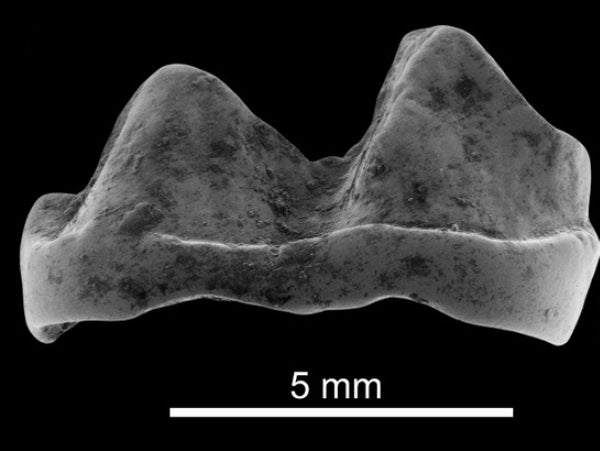
The pair of fossils, described by paleontologist Thierry Smith and colleagues, were extracted from Vastan Mine. This place has previously yielded the bones of animals called cambaytheres, close relatives to the last common ancestor of all the odd-toed ungulates, and now it seems there was a very early member of the tapir lineage living in the same forests. The cusps and troughs of the teeth, the paleontologists write, indicate that they belonged to a previously-unknown early tapir they've called Vastanolophus holbrooki.
For now, at least, Vastanolophus is the earliest member of the tapir lineage yet found. Paired with the cambaytheres in the same place, the researchers write, this might mean that the earliest ancestors of tapirs, horses, rhinos, and their kin popped up in Asia before rapidly dispersing around the world. Within two million years, for example, tapirs had crossed the Bering Land Bridge to what is now western North America, marking an early exchange in the Age of Mammals.

The dispersal of early perissodactyls around the world. From Smith et al., 2016.
Fossil Facts
On supporting science journalism
If you're enjoying this article, consider supporting our award-winning journalism by subscribing. By purchasing a subscription you are helping to ensure the future of impactful stories about the discoveries and ideas shaping our world today.
Name: Vastanolophus holbrooki
Meaning: Vastanolophus means Vastan Mine crest, in reference to where the mammal was found as well as the shape of the animal's teeth, while holbrooki honors fossil tapir expert Luke Holbrook.
Age: Eocene, about 54.5 million years old.
Where in the world?: Vastan Mine, western India.
What sort of critter?: A tapiromorph, or an early relative of today's tapirs.
Size: Not estimated, but said to be small.
How much of the creature’s body is known?: A molar and part of a premolar.
Reference:
Smith, T., Solé, F., Missiaen, P., Rana, R., Kumar, K., Sahni, A., Rose, K. 2016. First early Eocene tapiroid from India and its implication for the paleobiogeographic origin of perissodactyls. Paleo Vertebrata. doi: 10.18563/pv.39.2.e5
Previous Paleo Profiles:
The Light-Footed Lizard The Maoming Cat Knight’s Egyptian Bat The La Luna Snake The Rio do Rasto Tooth Bob Weir's Otter Egypt's Canine Beast
