
This article was published in Scientific American’s former blog network and reflects the views of the author, not necessarily those of Scientific American
Crocodylians are deceptive. I'm not just talking about their skill as aquatic ambush predators, concealed until the moment they're a blur of teeth and scales. Rather, the existing species of alligators, crocodiles, and gharials have often been incorrectly characterized as "living fossils" that have changed little since the Mesozoic. The fossil record readily dispels this notion, proving that crocodylians were even more varied in the past. With that in mind, Mourasuchus is a wonderful example of the greater crocodylian variety that once existed on our planet.
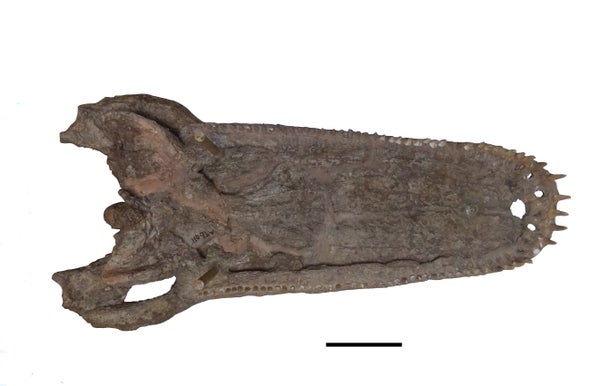
This weird caiman was first described in 1964 under the name Mourasuchus amazonensis. A handful of other species have been recognized since then, with the latest being Mourasuchus pattersoni named just this year by paleontologist Giovanne Cidade and colleagues from the Miocene strata of Venezuela. It's odd for a caiman. This was not a short-snouted little nipper, like the black caimans you've likely seen on natural history documentaries, but a long-faced crocodylian that looks like it's trying to do an impression of a baleen whale.
Such a strange skull is a sure sign Mourasuchus was doing something different than its modern relatives. But what? The long, wide snout with small teeth indicate that this caiman probably eschewed large, struggling prey for smaller fare. Following from this hypothesis, Cidade and coauthors suggest Mourasuchus a "gulp feeder" - a caiman that captured various small mollusks, crustaceans, and small fish en masse with its broad jaws. This wasn't filter feeding, the authors caution, as the caiman had no mechanism to separate sediment or plants from protein, but rather a uniquely crocodylian way of snaffling up little morsels in great quantities.

The skull of Mourasuchus pattersoni. Areas in white are fossil bone. Credit: Cidade et al. 2017
Fossil Facts
On supporting science journalism
If you're enjoying this article, consider supporting our award-winning journalism by subscribing. By purchasing a subscription you are helping to ensure the future of impactful stories about the discoveries and ideas shaping our world today.
Name: Mourasuchus pattersoni
Meaning: The species name pattersoni honors paleontologist Bryan Patterson.
Age: Miocene, about 8 million years ago.
Where in the world?: Falcón state, Venezuela.
What sort of organism?: A caiman.
How much of the organism’s is known?: A nearly-complete skull with assorted postcrania including vertebrae, ribs, elements of the hips, and osteoderms.
Reference:
Cidade, G., Solórzano, A., Rincón, A., Riff, D., Hsiou, A. 2017. A new Mourasuchus (Alligatoroidea, Caimaninae) from the late Miocene of Venezuela, the phylogeny of Caimaninae and considerations on the feeding habits of Mourasuchus. PeerJ. doi: 10.7717/peerj.3056
Previous Paleo Profiles:
The Light-Footed Lizard The Maoming Cat Knight’s Egyptian Bat The La Luna Snake The Rio do Rasto Tooth Bob Weir's Otter Egypt's Canine Beast The Vastan Mine Tapir Pangu's Wing The Dawn Megamouth The Genga Lizard The Micro Lion The Mystery Titanosaur The Echo Hunter The Lo Hueco Titan The Three-Branched Cicada The Monster of Minden The Pig-Footed Bandicoot Hayden's Rattlesnake Demon The Evasive Ostrich Seer The Paradoxical Mega Shark The Tiny Beardogs The Armored Fish King North America's Pangolin The Invisible-Tusked Elephant The Mud Dragon The Spike-Toothed Salmon The Dream Coast Crocodile Buriol's Robber Ozimek's Flyer The Northern Naustoceratopsian The High Arctic Flyer The Tomatillo From the End of the World The Short-Faced Hyena The Mighty Traveler from Egg Mountain Keilhau's Ichthyosaur Mexico's Ancient Horned Face Mauricio Fernández's Plesiosaur New Zealand's Giant Dawn Penguin The Orange Sea Lion Mongolia's Ginkgo Cousin The Geni River Frog Isabel Berry's Dinosaur
