
This article was published in Scientific American’s former blog network and reflects the views of the author, not necessarily those of Scientific American
When it comes to the fossil record, more attention always goes to the bizarre. The Bigger, toothier, and more lavishly ornamented, the better. Just as the dinosaurs. But as paleontologist William Parker once told me, every species has a fossil record. Petrified records peeled up at localities around the world help fill in the backstory of our modern biodiversity, connecting the present to the past. The latest example is a 52.2 million-year-old relative of tomatillos found in Argentina.
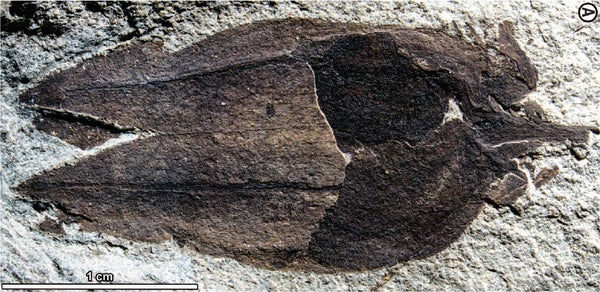
Paleontologist Peter Wilf and colleagues have just named the Eocene plant. They've called it Physalis infinemundi - the nightshade from the end of the world, referring to the fact this plant grew in the southern portion of the great supercontinent Gondwana just before it finally broke up.
The new fossil veggie belongs to a broader family of plants called the Solanaceae. This is the group that contains tomatoes, peppers, potatoes, and other familiar - not to mention tasty - plants. Up until now, the more familiar forms of these plants were thought to have evolved around 30 million years ago. As Wilf and colleagues report, though, the anatomy of Physalis infinemundi closely resembles that of groundcherries and tomatillos, meaning that derived species of Solanaceae were already around at 52.2 million years ago.
What makes Physalis infinemundi look so modern is the leafy wrapper around the fruit. This is because of a phenomenon called Inflated Calyx Syndrome, seen on modern relatives of the plant. Exactly why these plants evolved this feature isn't clear yet, but Wilf and colleagues think the early origin of the structures in wet, humid, lakeside environments might be a clue.
"Simple kitchen-sink and stream experiments on several Physalis species confirmed that intact calyces hold stable air pockets around the berry," Wilf and colleagues write, "enabling flotation for several days in water and prevents wetting of the berry during rains." The natural coat surrounding the fruit of a tomatillo might be a leftover from when their ancient ancestors evolved in waterlogged places. Think about that the next time you make salsa verde. You're tasting the legacy of the Eocene world.

Physalis infinemundi. Credit: Wilf et al. 2017
Fossil Facts
On supporting science journalism
If you're enjoying this article, consider supporting our award-winning journalism by subscribing. By purchasing a subscription you are helping to ensure the future of impactful stories about the discoveries and ideas shaping our world today.
Name: Physalis infinemundi
Meaning: Physalis is a genus of nightshade plant, and infinemundi is Latin for "at the end of the world."
Age: Eocene, 52.2 million years ago.
Where in the world?: Chubut Province, Argentina.
What sort of critter?: Part of the Solanaceae family, or nightshades.
Size: Stalk and fruit together are less than two inches long.
How much of the organism’s body is known?: Two fruits.
Reference:
Wilf, P., Carvalho, M., Gandolfo, M., Cúneo, N. 2017. Eocene lantern fruits from the Gondwanan Patagonia and the early origins of the Solanaceae. Science. doi: 10.1126/science.aag2737
Previous Paleo Profiles:
The Light-Footed Lizard The Maoming Cat Knight’s Egyptian Bat The La Luna Snake The Rio do Rasto Tooth Bob Weir's Otter Egypt's Canine Beast The Vastan Mine Tapir Pangu's Wing The Dawn Megamouth The Genga Lizard The Micro Lion The Mystery Titanosaur The Echo Hunter The Lo Hueco Titan The Three-Branched Cicada The Monster of Minden The Pig-Footed Bandicoot Hayden's Rattlesnake Demon The Evasive Ostrich Seer The Paradoxical Mega Shark The Tiny Beardogs The Armored Fish King North America's Pangolin The Invisible-Tusked Elephant The Mud Dragon The Spike-Toothed Salmon The Dream Coast Crocodile Buriol's Robber Ozimek's Flyer The Northern Naustoceratopsian The High Arctic Flyer
