
This article was published in Scientific American’s former blog network and reflects the views of the author, not necessarily those of Scientific American
Prehistoric boneyards always raise the same question. Why?
Fossilization is a fairly rare occurrence to start with. Most lives that ever have been lived left no record of their existence or passing. So when paleontologists come across dense pockets of bone, representing not just one animal but many, how such an ancient treasure trove was assembled is one of the core threads that we can pull on to unravel the mystery of a time long gone. So it is with a massive accumulation of sloths found in Santa Elena, Ecuador.
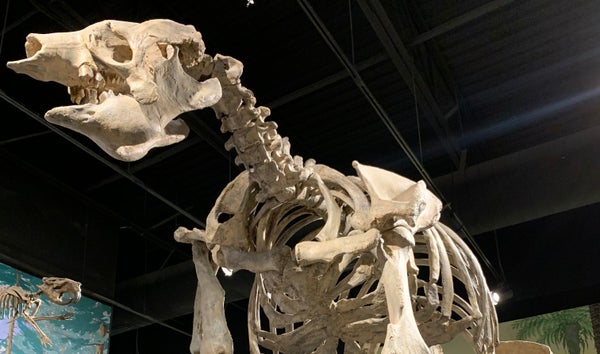
The site, called Tanque Loma, has just gotten a detailed description from paleontologist Emily Lindsey and colleagues. It’s a fantastically-rich Ice Age bonebed, containing the remains of at least 22 individual Eremotherium laurillardi – one of the largest of the giant ground sloths. What’s more, the bones are entombed in sediment rich in asphalt and the mashed-up plant material found at the site are the sloth’s feces, gut contents, or both. So how did so many sloths wind up buried in the same spot?
On supporting science journalism
If you're enjoying this article, consider supporting our award-winning journalism by subscribing. By purchasing a subscription you are helping to ensure the future of impactful stories about the discoveries and ideas shaping our world today.
First, the asphalt is something of a red herring. This place wasn’t a sticky trap like the famous La Brea asphalt seeps in Los Angeles. Instead, the bonebed was created in a watery environment that was later infiltrated by asphalt. Digging deeper, Lindsey and coauthors write, Tanque Loma was “a low-energy, anoxic, marshy aquatic environment” that sometimes went dry for long enough to let terrestrial plants to grow there. And this backdrop may hold the key to what befell the sloths.
Of 667 bones from Pleistocene megafauna at the site, 575 can be assigned to Eremotherium. This means that Tanque Loma is a monodominant bone bed. Bones from animals other than sloths have been found at the site, too, but the vast majority belonged to the shaggy, shambling sloths. Within that sample, the paleontologists estimate that the bonebed contains at least 22 individuals broken down into different age classes – 15 adults, one subadult, and six juveniles. The collected remains offer an outline of how Eremotherium grew up, and may indicate that this particular sloth species was social.
But why at this place, and why so many? There are other bonebeds near Tanque Loma, but none contain Eremotherium in such great abundance. And bonebeds like this can form in very different ways. Perhaps the sloths stuck around a dried-up watering hole too long. Maybe some local catastrophe killed a whole bunch of the sloths at once. Maybe this place took victims over time, with mud or some other trapping mechanism preventing sloth after sloth from escaping. Or perhaps ancient humans with a hunger for sloths created this site.
Hypotheses shift according to additional evidence, discovery, and discussion, but, as it stands now, Lindsey and colleagues suggest that something unfortunate happened at the watering hole. Perhaps an important water source dried up during drought, with the sloths unable to find, or travel to, another pool. Or maybe the dwindling water source became contaminated somehow, with thirsty sloths drinking toxic water and returning rains eventually burying the bones. Some modern animals die this way. Hippos, for example, sometimes end up being trapped by shrinking, increasingly-uninhabitable water sources, dying before the wet season can refresh their ponds.
Worse, the sloths may have hastened their own demise. The sheer amount of sloth-processed plant material at Tanque Loma may indicate that Eremotherium were social beasts that liked to wallow. And like modern hippos, they may have fouled their own water supply. Sloths pooping in the prehistoric pool isn’t a problem with a large body of water, but when there are fewer and fewer gallons for every sloth, the water becomes undrinkable and disease can spring up among the local population. Eventually, the sloths’ luck crapped out.