
This article was published in Scientific American’s former blog network and reflects the views of the author, not necessarily those of Scientific American
Dinosaurs are changing all the time. That might seem strange for animals known from petrified bones. Those skeletal parts are the biological core of the terrible lizards, stable through millions and millions of years. Yet our ideas about what dinosaurs were like is always shifting, their bodies rearranged and restructured. And it’s the classic dinosaurs – the species that defined saurian style in the 19th and early 20th centuries – that undergo the most change. Even though they’re familiar, they are also the most likely to be buffeted by scientific alterations. Just look at Ankylosaurus.
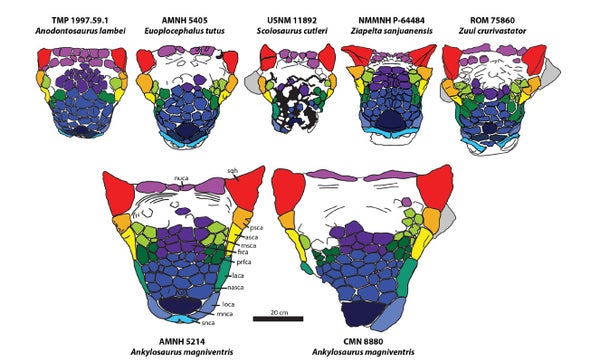
“Despite its household name status,” paleontologists Victoria Arbour and Jordan Mallon write in their new paper on the living tank, “Ankylosaurus is known from far fewer remains than its Campanian–Maastrichtian relatives Euoplocephalus and Anodontosaurus.” Fossils are scarce, and we’re far from a complete view of what this dinosaur really looked like. That’s why different experts have arranged and rearranged the look of Ankylosaurus over and over again during the past century. Some are fatter. Some are skinnier. Some have dense coats of armor and others have a wider spread. And while a more complete Ankylosaurus skeleton – hopefully preserved somewhere out there in North America – would go a long way towards restoring this low-slung plant chomper, Arbour and Mallon draw from other ankylosaur finds and analyses over the past decade to create a new image of the epitome of armored dinosaurs.

Different armor arrangements for Ankylosaurus. Credit: Arbour and Mallon 2017
On supporting science journalism
If you're enjoying this article, consider supporting our award-winning journalism by subscribing. By purchasing a subscription you are helping to ensure the future of impactful stories about the discoveries and ideas shaping our world today.
Just like Stegosaurus looks unusual compared to other stegosaurs, Ankylosaurus looks weird when placed side by side with its close relatives. The dinosaur’s teeth are relatively small for its jaws, its nostrils were placed towards the sides of the snout instead of at the front, and it was significantly larger than other ankylosaurs – some Ankylosaurus skulls are over one and a half times as broad as those of better-known anylosaurs like Euoplocephalus. And then there’s the armor.
Ankylosaurus was originally envisioned as having “a suit of armor of closely packed thoracic osteoderms”, or scutes, Arbour and Mallon write. This became the standard image, popularized throughout classic paleoart. And while other experts gave Ankylosaurus makeovers in 2003 and 2004, discoveries of other ankylosaurs in North America and Asia have provided additional information about how these dinosaurs wore their armor. The resulting image is still a hypothesis, naturally, but it presents an Ankylosaurus with broader spacing between relatively stubby scutes arranged in rows along its body. It’s not the dinosaurian armadillo envisioned in 1908, but an ornate animal that would have looked rather flashy.
This isn’t to say that we can confidently shelve Ankylosaurus again. Far from it. The weird positioning of its nostrils compared to related dinosaurs, for example, brings up plenty of functional questions. Could this placement be a sign of an adaptation – like being able to smell in stereo or rooting around in the dirt, hypotheses Arbour and Mallon regard as up in the air – or is it a happenstance from some other change? And why did such a large ankylosaur have tiny teeth? Not to mention that the tail club of Ankylosaurus isn’t really much different in size from other smaller species, which could indicate some kind of limit to tail club size regardless of body mass. In other words, don’t take Ankylosaurus for granted. We’re really only just getting to know the fused lizard.
This post was supported by my generous backers on Patreon. For details on how you can get an early view of new blog posts and exclusive natural history essays, click here.
Reference:
Arbour, V., Mallon, J. 2017. Unusual cranial and postcranial anatomy in the archetypal ankylosaur Ankylosaurus magniventris. Facets. doi: 10.1139/facets-2017-0063