
This article was published in Scientific American’s former blog network and reflects the views of the author, not necessarily those of Scientific American
New species dominate fossil news. A new dinosaur is named about every two weeks, for example, and that’s to say nothing of the millions and millions years filled with organisms that we are just getting to know. But anatomical novelty is only part of the story. Each newly-discovered species becomes another thread in the history of life, interwoven with many others. Where a species existed in space and time can be just as important as what it looks like or what it’s related to. Consider a fossil marine reptile found in Alaska.
Thalattosaurs don’t enjoy the same press as Mesozoic celebrities like ichthyosaurs and plesiosaurs. These creatures make up just one of many unusual reptile lineages that took to the seas during the Triassic, between 251 and 200 million years ago, but didn’t survive past the end of the period. And even though it’s not clear who their closest relatives are, thalattosaurs looked something like pointy-snouted lizards that paddled around relatively warm waters near the shore. Gunakadeit joseeae, named by paleontologist Patrick Druckenmiller and colleagues, kept similar habits, and was one of the last of its kind.
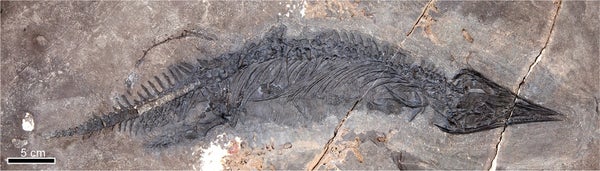
Gunakadeit - a Tlingit word for sea monster - stands out partly because of how much of the first individual’s skeleton made it into the fossil record. This particular species is “the first articulated and substantially complete thalattosaur fossil from North America,” the researchers write, consisting of a skull and most of the rest of the body. Parts of the tail and the ends of the limbs are missing, but, even with these lost pieces, the thalattosaur is exceptional. The fossil is even articulated, the bones more or less in place after burial. The skeleton offers a rare look at a variety of reptile that’s often only represented by bits and pieces.
On supporting science journalism
If you're enjoying this article, consider supporting our award-winning journalism by subscribing. By purchasing a subscription you are helping to ensure the future of impactful stories about the discoveries and ideas shaping our world today.
Compared to other thalattosaurs, Gunakadeit is small. The living animal was only about three feet long, significantly shorter than other thalattosaurs that could get to be over fifteen feet in length. It’s probably a juvenile or subadult animal, Druckenmiller and coauthors hypothesize, although even then it’s still in the shallow end of the size range for the family. The snout of the animal is long and pointed, with small needle-like teeth. Gunakadeit probably nabbed soft-bodied invertebrates in mid-water and wriggled other morsels out of nearshore reefs or crevices. Even though thalattosaurs are rare, the paleontologists note, their skulls and teeth vary widely and likely represent very different ways of feeding.
What makes Gunakadeit especially important, though, is when it lived. This thalattosaur lived about 215 million years ago, making it one of the geologically youngest ever found. The reptile indicates that even close to the end, thalattosaurs maintained their roles as nearshore predators – and this may have been their undoing.
While there’s always the potential for an unexpected reversal thanks to a new find, it seems that thalattosaurs never became as adapted to life in the oceans as other marine reptiles. None of the known species show specializations for life in the open seas. This may have made thalattosaurs vulnerable to sea level changes and other ecological shifts, while a broader array of ecological roles allowed creatures like ancestral ichthyosaurs and plesiosaurs to persist for tens of millions of years more. "That's my niche and I'm sticking to it," isn't always a wise survival strategy.