
This article was published in Scientific American’s former blog network and reflects the views of the author, not necessarily those of Scientific American
On supporting science journalism
If you're enjoying this article, consider supporting our award-winning journalism by subscribing. By purchasing a subscription you are helping to ensure the future of impactful stories about the discoveries and ideas shaping our world today.
The fossil record holds the stories of life on Earth, and, as the interpreters of these stories, paleontologists are naturally curious about beginnings and endings. Look at an prehistoric organism, familiar or new, and the immediate question following “What is that?” tends to be how such a lifeform came to be in the first place. For a long time, such puzzles were left totally open. That’s why Charles Darwin devoted a significant portion of On the Origin of Species to emphasizing that the fossil record is both incomplete and incompletely known. In the last four decades, however, the revival and growth of paleobiology has started to add new flourishes to classic tales and, in some cases, bring us closer to those early chapters we’ve previously been missing.
From the city park to the deep sea, molluscs flourish in our modern world. Snails and cephalopods alike carry on a legacy that kicked off over 520 million years ago, back when all animal life made its home in the sea. But what did the ancestors of today’s varied and squishy molluscs look like? A recent find in Morocco, paleontologist Jakob Vinther and colleagues propose, helps bring us closer to that ancient form.
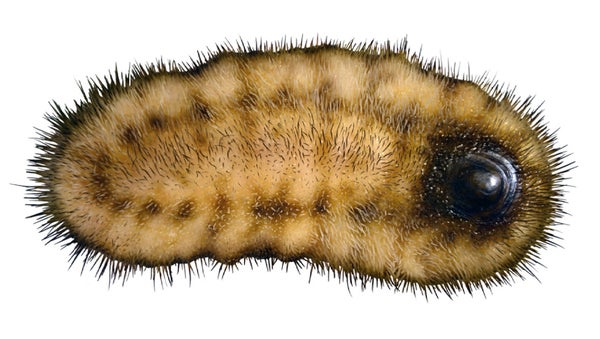
At first glance, little Calvapilosa kroegeri might not look like a rock star. The 478 million-year-old invertebrate resembles a very hairy thumb. But a lack of charisma doesn’t translate to a lack of importance. Calvapilosa has the distinction of being part of a fossil community no one expected – sea creatures that resemble those of the famous Burgess Shale and were thought to have gone totally extinct, yet persisted in this pocket of ancient Morocco for tens of millions of years longer. More than that, Vinther and coauthors write in the paper describing this fuzzy beastie, Calvapilosa helps refine our image of what the earliest molluscs were like.

A fossil of Calvapilosa. Credit: Vinther et al. 2017
If you could see Calvapilosa in life, the creature would look something like a spiny slug wearing a helmet. Looked at from below, however, you would see two rows of rasping teeth. This is a radula – a structure only found in molluscs.
Of course, no fossil stands alone. What’s new is always compared to what’s been found before. In this case, the anatomy of Calvapilosa brings together a few more ancient enigmas near the base of the mollusc family tree. The older fossil invertebrates Halkieria and Orthrozanclus, which had previously been identified as everything from early segmented worms to eo-brachiopods, turn out to be close relatives of Calvapilosa and together represent the early days of the lineage that would eventually spin off the chitons you can find clinging to tidepool rocks today.
This shifting around alters what paleontologists expect of early mollusc anatomy. Up until recently, Vinther and coauthors write, the ancestral mollusc was thought to lack a shell and resemble worm-like forms found in the deep sea today. Within the context of the altered family tree spurred by Calvapilosa, however, Vinther and colleagues suggest that the earliest molluscs had a single shell as well as that distinctive radula. From that start, the paleontologists write, molluscs evolved such a dazzling array of body types that it “confounded previous attempts to reconstruct the evolutionary history of the group” – frustrating to paleontologists, but a true testament to molluscan success.
Reference:
Vinther, J., Parry, L., Briggs, D., Van Roy, P. 2017. Ancestral morphology of crown-group molluscs revealed by a new Ordovician stem aculiferan. Nature. doi: 10.1038/nature21055
