
This article was published in Scientific American’s former blog network and reflects the views of the author, not necessarily those of Scientific American
If you want to get technical, the Age of Dinosaurs began about 235 million years ago. That’s when the first lanky little dinosaurs started scurrying around the Triassic world. But dinosaurs didn’t rule the Earth. They weren’t really ruling anything. Back then, dinosaurs were relatively rare and ecologically marginal animals compared to the other reptiles of their time. It took a mass extinction – roundabout 200 million years ago – to remove the competition and allow the surviving dinosaurs to flourish. This time, the dawn of the Jurassic, is when dinosaurs staged their terrestrial takeover, and a new study based on finds in southern Africa focuses on this time as the rise of dinosaurian giants.
The largest dinosaurs of all time – like Supersaurus and the recently-named Patagotitan – were the long-necked, pillar-limbed sauropods. But these dinosaurs didn’t just pop into existence out of thin air. They were the impressive expressions of evolutionary trends that had been going on for tens of millions of years. Pulling back the focus just a little, the sauropods belonged to a wider group of dinosaurs called the sauropodomorphs – basically, sauropods and their closest relatives – that go all the way back to the early days of the dinosaurs.
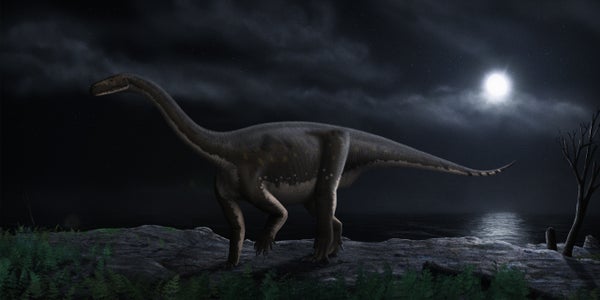
Early sauropodomorphs were pretty small. Panphagia from the Triassic of South America was about the size of a medium-sized dog. Nor did it look like a Brontosaurus. Early sauropodomorphs of the Triassic and early Jurassic were bipedal animals which looked increasingly awkward as they started to evolve long necks and larger sizes. And if you want to get to know these dinosaurs, there’s hardly a better place to look than the Elliot Formation of Lesotho and South Africa – a geologic chapter that contains an abundance of sauropodomorphs over the transition between the Triassic and Jurassic worlds. This is the slice that paleontologist Blair McPhee and colleagues have centered on for a reconsideration of sauropodomorphs during this critical time.
On supporting science journalism
If you're enjoying this article, consider supporting our award-winning journalism by subscribing. By purchasing a subscription you are helping to ensure the future of impactful stories about the discoveries and ideas shaping our world today.
The scientific term for what McPhee and coauthors have done is biostratigraphy. That’s documenting the succession of species through time as finely as possible. This is the sort of practice that’s useful in determining what was going on prior to an extinction, who followed whom in the fossil record, and the radiation of life in the aftermath of catastrophes. And given the number of sauropodomorph discoveries made in southern Africa over the past three decades, the time was right to revise what was previously thought.

Sauropodomorph stratigraphy in southern Africa. Credit: McPhee et al 2017 (CC BY 4.0)
Part of what made the revision necessary was the way sauropodomorphs were previously divvied up through time in this region. Given that larger dinosaurs were logically thought to follow smaller species, small or more gracile sauropodomorphs were often cast as older while more robust and large-bodied forms were considered relatively younger. But the reorganization found different mixes of sauropodomorphs through time. Although the dinosaurs from the Late Triassic part of the slice are less complete, the overall picture is that they were relatively similar to each other in overall form. They were not very disparate. By the Early Jurassic, however, McPhee and colleagues point out several different anatomical types ranging from classic, slim sauropodomorphs, hefty high-browsers, and some difficult-to-place forms like Aardonyx. Even though sauropodomorphs were the largest dinosaurs of their time in the Late Triassic, they weren’t truly getting large and splitting into more varied forms until the dawn of the Jurassic.
So sauropodomorphs stand out as something of an exception to the dinosaurian rule. The extinction that eventually gave other dinosaurs – like small carnivores – an edge didn’t really seem to do much for the sauropodomorphs. That’s because these dinosaurs were already filling the large herbivore niche, McPhee and colleagues point out, and had already evolved some of the hallmark characteristics of the group. What unfolded in the first fifteen million years of the Jurassic was a continuation of trends already in place. Whatever happened to the Early Jurassic world only encouraged the sauropodomorphs further, and while those early body plans would eventually disappear, the sauropods who rose out of this ancestral stock became some of the most astonishing animals the world has ever seen.
Reference:
McPhee, B., Bordy, E., Sciscio, L., Choiniere, J. 2017. The sauropodomorph biostratigraphy of the Elliot Formation of southern Africa: tracking the evolution of sauropodomorpha across the Triassic-Jurassic boundary. Acta Palaeontologica Polonica. doi: 10.4202/app.00377.2017

