
This article was published in Scientific American’s former blog network and reflects the views of the author, not necessarily those of Scientific American
It’s something of a scicomm trope to say we're looking at the past through the “lens of Deep Time.” It’s one I try to avoid, much like the dreaded “shedding light” on a topic. But I mention the meme here for a particular reason. The lens of Deep Time is often focused on the charismatic and transcendental. The evolution of the first birds from feathered dinosaurs would be something you’d expect to see through the lens of Deep Time. But, like all lenses, some parts of reality are often left out of the resulting picture. Like parasites.
"Parasites are common in many ecosystems, yet because of their nature," zoologist Tommy Leung writes in a new paper, “they do not fossilise readily and are very rare in the geological record.” This is a significant problem, and one that affects how we see ancient life. Dinosaurs and many of our other prehistoric favorites are often visualized and interpreted as perpetually-healthy organisms, bone pathologies being the rare clues as to ailments and injury. Yet we know that the history of parasites must run deep and influenced evolution. The fossil record simply isn’t complete without the consideration of various worms, athropods, fungi, and other organisms that live off other species. To that end, Leung set about gathering what’s known of biological opportunists and hitchhikers from what’s left in the rock.
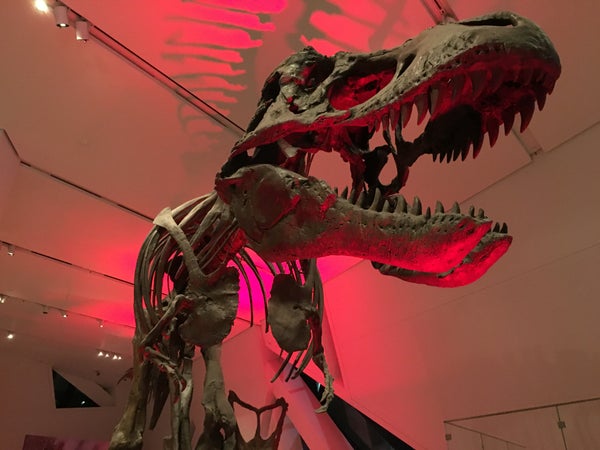
"Parasite" is a very wide category, of course. In addition to fossils of free-living parasites, there are parasites preserved with their hosts, eggs, and evidence of parasite-caused damage, Leung notes. Paleontologists have found fossil flukes, fossil fleas, fossil ticks, fossil hairworms, and more, including lesions on the jaws of tyrannosaurs that indicate the presence of lesion-causing microorganisms that invaded that upper digestive tracts of the carnivorous celebrities. And in many cases, the fossil parasites infested and affected animals similar to those that their living relatives still do. Arthropod parasites called copepods made themselves at home in the gills of Cretaceous fish just like some copepods do today.
On supporting science journalism
If you're enjoying this article, consider supporting our award-winning journalism by subscribing. By purchasing a subscription you are helping to ensure the future of impactful stories about the discoveries and ideas shaping our world today.
Looking beyond these case studies, though, paleontologists can start to get at some broader questions. We don’t really know how mass extinctions affected parasites for example. The rapid loss of many host species surely must have affected parasites and put increased evolutionary pressures on them. Likewise, the presence of some forms of parasite with well-known life cycles could provide insights into the biology of their hosts. Tiny worms called nematodes, for example, can help paleontologists understand the to-ing and fro-ing of mammals when the Americas joined and the famous biotic interchange of those continents ensued.
But perhaps Leung’s most important point is the simplest. We often forget parasites and the role they play in our ecosystems. At times they can almost seem outside nature, as if they were cheating to get by rather than being just as evolved as any other form of life. So the next time you see an illustration of a majestic prehistoric creature - be it shark, mammoth, dinosaur, or something else - take a moment and consider the ecosystem of other species that single organism was home to.