
This article was published in Scientific American’s former blog network and reflects the views of the author, not necessarily those of Scientific American
If there’s any geological unit that encapsulates the wonder of the Age of Dinosaurs, it’s the Morrison Formation. The purple, maroon, and gray stacks of rocks seen across the American west have yielded some of the largest, strangest, and most ferocious creatures to have walked the Earth, with forms like Stegosaurus and Ceratosaurus fueling the Bone Wars of the 19th century and newer finds like the tiny, tusk-toothed Fruitadens filling out the nature of what must have been a truly spectacular ecosystem. But we’re still just getting to know this classic patch of Jurassic stone. For starters, paleontologists are still working out which dinosaurs rubbed shoulders with whom.
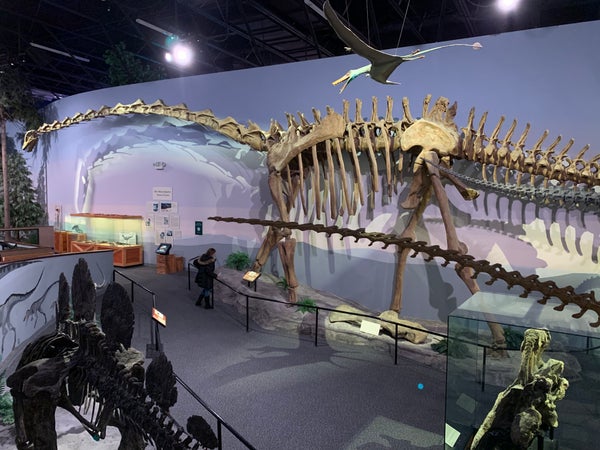
Who stomped around when, and where, is at the center of a new review by paleontologist Cary Woodruff. To date, experts have named 13 genera and 24 species of sauropods alone from the Morrison Formation. If all these dinosaurs lived in the same place at the same time – with the likes of Dystrophaeus and Brachiosaurus, Apatosaurus and Camarasaurus mingling together – Morrison Formation ecosystems would have been unlike anything the planet had seen before or has evolved since. The amount of green food required to support such an assemblage would have been incredible.
But we know that not all these dinosaurs occupied the same space. Dystrophaeus is the oldest known sauropod from North America, for example, and lived millions of years before the likes of Diplodocus. Brachiosaurus, by contrast, is a relatively rare dinosaur while Camarasaurus had a greater presence through time and over space. When we talk about the diversity of the Morrison Formation, in other words, we’re really talking about hundreds of thousands of square miles that represent over 7 million years, itself only a partial picture of particular depositional settings in a much wider world. If we want to understand what any given fossil locality was like circa 150 million years ago, a finer-scaled approach is needed.
On supporting science journalism
If you're enjoying this article, consider supporting our award-winning journalism by subscribing. By purchasing a subscription you are helping to ensure the future of impactful stories about the discoveries and ideas shaping our world today.
The task doesn’t hinge on any single problem, Woodruff points out, but several. There are taxonomic tangles over species names that go back over 150 years. Determining which species of Camarasaurus need revision out of several is a huge task that could be a career’s worth of work, trying to update a dinosaur that was named in 1877. On top of that, there are doubtful species – like the legendary “Amphicoelias fragillimus” that was named from a long-lost vertebra – and others may be growth stages of known animals. While currently categorized as a unique species, Woodruff points out, the giant Diplodocus hallorum is only known from large individuals and could just be large or mature forms of an already-known species.
Then there’s time and space. If you go to a place like Dinosaur National Monument or Cleveland-Lloyd Dinosaur Quarry, which preserve bones from dozens to hundreds of individual dinosaurs, you won’t find a complete list of all the sauropods found in the Morrison Formation. There are only a few species. Some seem common. Others are rare. And even then, while we can assume common forms like Camarasaurus lived in the area, are the rare forms just fewer in number or are they representatives of populations that preferred a different place but sometimes overlapped or somehow wound up buried out on the floodplains? Nor did all the sauropods live at the same time. Camarasaurus lewisi is older than Camarasaurus lentus, which is older than Camarasaurus supremus, although whether these animals represent one lineage changing over time, the branching of species, or a persistent species that needs to be revised isn’t known.
Looking at the corrected stacks of dinosaurs, based on what’s known now, there are certain Morrison Formation times that boasted more sauropod diversity than others. The Tidwell Member of the Morrison, near the bottom, seems to have three very different sauropod species. By the middle part of the Brushy Basin Member, though, there may have been as many as a dozen sauropod species over a broad range. The quirks of the fossil record and discovery come into play here. It’s far easier to find dinosaurs in the Brushy Basin layers than the much older Tidwell layers, for example, and so paleontologists have historically gone where the fossils are abundant. But coming up with a living map – what dinosaurs lived where, and when – is a basic step towards putting ourselves back into those hot and conifer-shaded days of the Morrison. The strata may be familiar, but that doesn’t mean we know it well just yet.