
This article was published in Scientific American’s former blog network and reflects the views of the author, not necessarily those of Scientific American
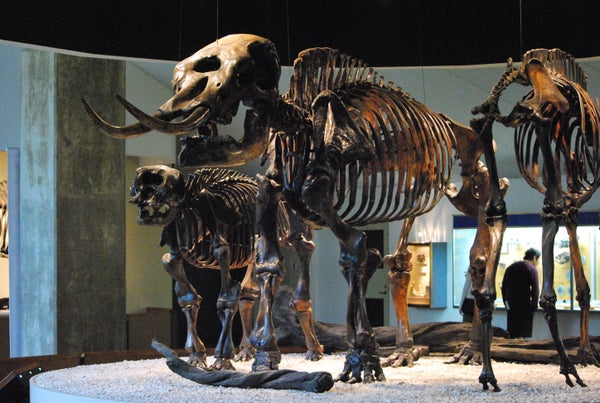
Maybe it’s the contrarian streak in me. Maybe it’s because I know mammoths get better press. But I have a soft spot for the American mastodon. This “bubby toothed” beast was one of the two great elephants roaming around North America during the last Ice Age, yet, despite being a focal point for scientific curiosity in the late 18th century, it just isn’t quite so beloved as the continent’s mammoth.
I’m not entirely sure why. Perhaps it’s the low-domed profile and shorter stature. Mastodons are to mammoths as Neanderthals are to Cro-Magnons. They just don’t look as regal. Then again, that could be a problem with paleo PR. We pick certain species to celebrate and others to ignore, or even denigrate, all the time. It might just be that mammoths stole our hearts and we don’t have room for mastodons.
For my own part, the fact that mastodons are often overlooked only makes them all the more charming to me – “Dude, I was into Mammut before they were cool” – not to mention that they should still be here. They were beasts suited to the warmer interglacial times of the Ice Age, and they wouldn’t look amiss trundling through our modern forests. And, in fact, a new study by paleontologist Chris Widga and colleagues only adds to the mystery of why our mastodons disappeared practically yesterday.
On supporting science journalism
If you're enjoying this article, consider supporting our award-winning journalism by subscribing. By purchasing a subscription you are helping to ensure the future of impactful stories about the discoveries and ideas shaping our world today.
No one really knows what happened to the last mastodons. Yes, human hunting, climate change, and other explanations have been forwarded, but these don’t really tell us very much at all about the mechanics of how a species disappears. They’re broad brush strokes. To get at why Mammut aren’t around anymore, we need a better idea of what their populations were doing prior to their extinction. That’s what the new paper by Widga and colleagues focuses on, tracking the fate of the American mastodon in the center of North America.
If you’re going to follow mastodons, the Midwest is a great place to do it. Widga and coauthors count 281 localities from the Ozarks to Ontario. And while mammoth remains are commonly found in the same area, who the dominant elephant on the landscape was really depended on the time.
During the Last Glacial Maximum – when the climate was colder, more arid, and the landscape was more open – mammoths reigned supreme. But as the glaciers receded and forests expanded over the former parkland and taiga, between 14,600 and 12,800 years ago, mastodons became much more numerous. In short, mammoths did well when it was cold and dry while mastodons prospered when it was comparatively warm and wet.
And, apparently, mastodons were doing quite well just before they disappeared.
Drawing from radiocarbon dates of proboscideans across the central part of North America, Widga and colleagues outlined what was happening to American mastodons towards the end of the Ice Age. They didn’t find a slowly dwindling population. Quite the opposite. In the window of time between 14,600 and 12,800 years ago, the researchers found that “mastodons are geographically widespread and morphologically variable which is consistent with the interpretation of a large regional population.” As the climate changed, and well after humans had made a home on North America, the American mastodon kept on plodding down its evolutionary path.

A timeline of mastodon and mammoth extinction in the Midwest. Credit: Widga et al 2017
So what happened? Why can’t I still see mastodons pushing over trees when I hike up into the foothills around my Salt Lake City home? Unfortunately, there’s no definitive answer yet. At this point it’s still a matter of looking at which hypotheses are better supported than others.
It’s unlikely that humans extirpated the Midwest’s mastodons. There’s no sign of a “blitzkrieg” of ravenous people slaying proboscideans left and right. There are only three proboscidean sites in the region that show evidence of hunting or butchery by humans, and, in any case, mastodons go extinct centuries if not millennia after humans arrive in the area. For now, there’s just no evidence that people drove the American mastodon to extinction. Likewise, the role climate change played in the mastodon’s extinction is unclear. Even though the American mastodon disappears from the Midwest within the window of a brief cold snap called the Younger Dryas, the effects of this chill was not so extreme in the region as sometimes portrayed. Mastodons should have been able to survive this climate jolt just as they had previous swings of glaciation.
But there might be something else. Something that doesn’t involve what’s seen in the fossil record, but what’s missing. Large carnivores – think short-faced bears, sabercats, and the like – are rarely found in Midwest sites of the same age as the mastodons. There’s little evidence of predation or even gnawing on bones. This might be a clue to extinction that was previously overlooked.
Fights between sabercats and adult mastodons were probably rare events, if they ever happened at all, but we know Ice Age carnivores were capable of making meals of juvenile proboscideans. Friesenhahn Cave in Texas, for example, is a sabercat den littered with the remains of juvenile mammoths. By preying on young mammoths and mastodons, these carnivores helped control their population and shaped the landscape. But consider what may have happened in the Midwest. If large carnivores were relatively rare, Widga and colleagues propose, mastodon populations could have boomed and would have been limited by available plant food rather than predators.
That might sound good for the mastodons, but it can also make big herbivores more vulnerable. Their populations fall into boom-bust cycles where perturbations from climate change, like drought or disease outbreaks, cut back populations with greater severity. Strange as it may seem, the apparent success of the mastodons may have been a sign of their weakness, and a new clue as to why we lost these magnificent beasts.
Reference:
Widga, C., Lengyel, S., Saunders, J., Hodgins, G., Walker, J., Wanamaker, A. 2017. Late Pleistocene proboscidean population dynamics in the North American Midcontinent. Boreas. doi: 10.1111/bor.12235
