

This article was published in Scientific American’s former blog network and reflects the views of the author, not necessarily those of Scientific American
Why are all the giant sloths extinct? Paleontologists have been pondering this question, along with the fate of the other charismatic Ice Age mammals that roamed the Americas, for decades, with hunting by hungry humans and ecological changes in a warming climate standing out as the most conspicuous culprits. One has usually been implicated to the exclusion of the other. But now paleontologist Jessica Metcalf and an interdisciplinary team of colleagues have added new evidence to a hypothesis that has been gaining ground in the last few years. For the megamammals of South America, at least, it wasn't climate change or humans alone that tipped so many species into extinction. It was both.
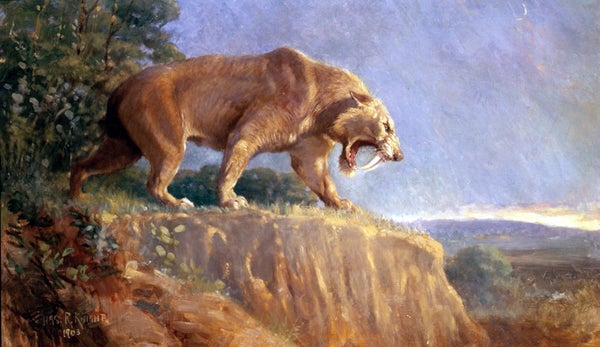
Much of the debate over what stripped the world of mammoths and sabercats has focused on the Americas. That's because the arrival of humans in North and South America seemed conspicuously close to when the dire wolves and native horses died out. Yet this is a pattern, not an explanation, and the big picture has changed with the flow of analysis and discovery. In this case, Metcalf and her coauthors did not find a blitzkrieg led by ravenous humans. The disappearance of Smilodon populator and its neighbors was more complicated.
After obtaining genetic snippets from 89 Ice Age mammal bones found in Patagonia and radiocarbon dates from 71 bones from the same area, the researchers found that South America's sharp extinction pulse took place about 12,280 years ago. This is between 1,000 and 3,000 years after humans first arrived on the continent. In fact, extinction's edge didn't start winnowing away the larger species until the climate started to warm.
On supporting science journalism
If you're enjoying this article, consider supporting our award-winning journalism by subscribing. By purchasing a subscription you are helping to ensure the future of impactful stories about the discoveries and ideas shaping our world today.

The extinction of South American megafauna. From Metcalf et al., 2016.
South America lost 52 unique genera of large mammals. This, Metcalf and coauthors write at the outset of their study, was the most severe loss seen on any continent. There was no single trigger that explains the faunal devastation. Humans hunted some of South America's large mammals, as archaeological sites show, but this wasn't enough to drive so many species into oblivion. Humans and the likes of giant sloths and sabercats coexisted for over a thousand years, at minimum.
Climate change altered the scenario. As South America warmed, forests dominated by beech trees began to spread. The large mammals faced the recurring pressure to adapt or die, but, in a changing and diminished habitat, hunting by humans took a heavier toll. The loss of keystone species that changed habitats by, for example, pushing down trees or dispersing seeds, further exacerbated the breakdown. In the end, unfortunate happenstance left us with a world where we can still see the spectres of animals that disappeared practically yesterday.
Reference:
Metcalf, J., Turney, C., Barnett, R., Martin, F., Bray, S., Vilstrup, J., Orlando, L., Salas-Gismondi, R., Loponte, D., Medina, M., De Nigris, M., Civalero, T., Fernández, P., Gasco, A., Duran, V., Seymour, K., Otaola, C., Gill, A., Paunero, R., Prevosti, F., Bradshaw, C., Wheeler, J., Borrero, L., Austin, J., Cooper, A. 2016. Synergistic roles of climate warming and human occupation in Patagonian megafaunal extinctions during the Last Deglaciation. Science Advances. doi: 10.1126/sciadv.1501682