
This article was published in Scientific American’s former blog network and reflects the views of the author, not necessarily those of Scientific American
We often imagine dinosaurs in one of two states – in the prime of their lives, or dead, serving as food for another creature. This is the plastic toy set version of prehistory, where every animal has a glistening polish or has their guts hanging out. Yet we know this isn’t biological reality. Pathological bones indicate that dinosaurs suffered bacterial infection, fractures, bone cancer, and other ailments, just like modern vertebrates do. And, as pointed out by Les Heam and Amanda de C. Williams, dinosaurs certainly felt pain.
Precisely how Triceratops and its varied non-avian relatives perceived pain is a question that remains inaccessible to us. Understanding pain in modern organisms is fraught enough. But being that dinosaurs were living animals with a full complement of organs and soft tissues provided by evolution - brains, nerves, and pain-detecting receptors that come standard in vertebrates - we can at least say that dinosaurs were indeed capable of feeling stimuli that told their brains “Ow! Let’s move away from that.” And there does appear to be fossil evidence to back up that idea.
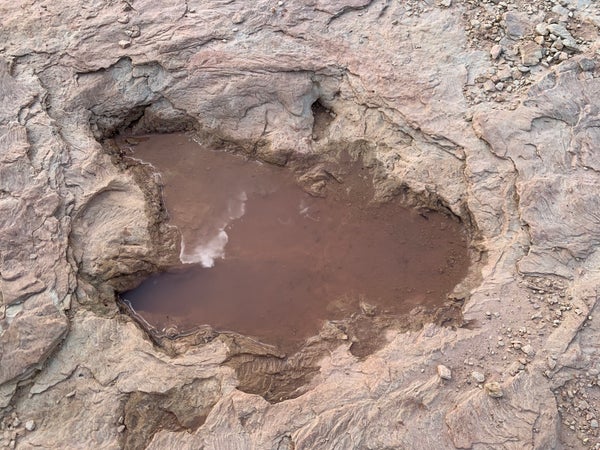
One of the most direct pieces of evidence is a few miles off the road near Moab, Utah. The Copper Ridge tracksite is famous for recording the steps of an Allosaurus-like dinosaur that limped as it walked. While it’s possible that there was some unknown biomechanical reason that this dinosaur should leave a limping trackway behind, it’s more likely that this theropod suffered some injury that made it painful to walk and therefore favor one leg over the other. The fossilized behavior testifies to Jurassic pain.
On supporting science journalism
If you're enjoying this article, consider supporting our award-winning journalism by subscribing. By purchasing a subscription you are helping to ensure the future of impactful stories about the discoveries and ideas shaping our world today.
But there’s more. There are dozens of papers related to dinosaurian aches, from fossil evidence associated with such hurts to what we may be able to deduce from looking at modern birds. While perhaps rare compared to the total number of dinosaur bones unearthed to date, there’s no shortage of evidence of presumably painful injury during the Mesozoic – the authors counted 209 injuries on dinosaur bones, with about 38% relating to the hind limbs, 25% to the front limbs, and the rest divided between other parts of the skeleton. Some specimens - like the famous Tyrannosaurus "Sue" - had multiple injuries that underscore how difficult life could be for an apex predator.
Falls, fights, ill-timed bites, and more, dinosaurs dealt with much the same pains as modern reptiles, birds, and mammals. The record is in their bones. But what did dinosaurs feel, and how did they react to pain? We’re still a long way from a veterinary manual for non-avian dinosaurs, but there are a few clear takeaways.
In modern creatures, an animal in pain may isolate themselves, lose their appetite, become easily aggravated, and show other signs that they're hurting. Now here's the tricky part. We can’t observe a solitary and grumpy Tyrannosaurus with a broken leg or an Apatosaurus who hangs back from the herd due to an upset stomach. Nor has anyone – yet – found evidence of an injured dinosaur that must have been in pain from an injury but survived with the help of a social group, as proposed from some ancient humans and even Smilodon at the La Brea asphalt seeps. But the fact that paleontologists have uncovered limping dinosaur tracks and fossil evidence of injuries we know cause pain in modern animals hints that dinosaurs dealt with these stresses, too. And that follows logically from some of the behavior seen in the bones – what’s the point of biting your rival on the face or whipping your tail at an attacker if they cannot feel such blows and be deterred?