
This article was published in Scientific American’s former blog network and reflects the views of the author, not necessarily those of Scientific American
I’m typing these words, pushing each key in succession, with the complement of ten fingers evolution gave me. They’re part of my hands, attached to the ends of my arms. My legs follow the same anatomical format, just with feet and toes at the end instead of a copied hand.
It’d be easy to take this skeletal formatting for granted. Not only is it standard for Homo sapiens, but I share this basic framework with most tetrapods. Naturally there are exceptions – like two-toed sloths and legless lizards – but my essential appendages are really just slightly-modified versions of what four-limbed vertebrates have been using to interact with the world since the time our ancestors were swimming around in the shallows of plant-choked swamps over 375 million years ago.
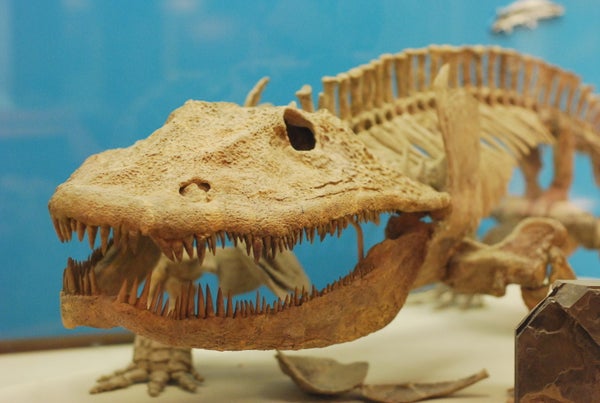
Exceptional fossils and new analytical techniques have turned the evolutionary transition from finned-fish to four-limbed vertebrate into one of the classic tales of life’s history. Tiktaalik is as much of a household name as any Devonian vertebrate could ever hope to be. Yet the story’s not all told yet. Why our arms and legs are so similar, and how five came to be the basic accompaniment of tetrapod digits, are puzzles that keep inspiring scientists to go back to the murky Devonian depths. Anatomist Borja Esteve-Altava and a group of five coauthors have done just that in a study of how fins eventually became limbs.
On supporting science journalism
If you're enjoying this article, consider supporting our award-winning journalism by subscribing. By purchasing a subscription you are helping to ensure the future of impactful stories about the discoveries and ideas shaping our world today.
Let’s go back to a time before limbs, over 400 million years ago. Our ancestors then were among lobe-finned fish, with chunky bones held inside fleshy fins. This setup set the foundation for our own limbs. All the same, it's easy to spot some significant differences, too. These fish didn’t have digits, but instead had a kind if skeletal fringe around the outer portion called lepidotrichia. Furthermore, at different times the pectoral and pelvic fins – equivalent to our arms and legs, respectively – varied from each other in structure and function, evolution shifting the similarity between these fore and aft structures back and forth through time. When the pectoral and pelvic appendages more closely resembled each other, Esteve-Altava and colleagues dub these “bottlenecks” that appear to be related to new groups of organisms splitting off from their parent group.
Such a bottleneck occurred around the origin of lobe-finned fish. But what about the tetrapods that then split off from this group? Esteve-Altava and colleagues looked at the topological arrangement of bones in fish and tetrapods that spanned the origin of limbs, using a network approach to detect how skeletal changes related to the complexity of anatomical arrangements.
Evolution doesn’t proceed in a straight line towards a future goal, of course. There was no march of progress towards digit-bearing appendages. Still, among the various expressions of fin and limb, Esteve-Altava found several key factors that were critical to the critical transformation. Most important of all was the evolution of digits. The origin of fingers and toes was tied to a significant anatomical change that immediately differentiated the first tetrapods from their more fishy ancestors. In short, the number of bones increased with the evolution of digit-bearing hands and feet, but the overall complexity of the appendage shape decreased into a setup of more stiffened joints.
Despite the fact that digit-bearing limbs were an evolutionary novelty, though, the arms and legs across early tetrapod species were very similar to each other. Arms and legs would eventually open up all sorts of biomechanical possibilities, but, in the evolutionary moment spanning the water and land, they shared basic functions related to bearing weight and moving around. Long, long before bats could fly with wings, moles could dig with clawed arms, and we could run, tetrapods were moving out of the swamps and onto land. This molded the basic shape limbs would take. The various constraints of that moment opened new possibilities and closed others, forming the skeletal foundation for everything from the bones in your body to the wingbeats of the chickadee that flutters by outside.