
This article was published in Scientific American’s former blog network and reflects the views of the author, not necessarily those of Scientific American
Some dinosaur discoveries get coverage equal in size to the animal’s stature. The announcement of “The Titanosaur”, currently looming over visitors to the American Museum of Natural History, was impossible to miss, and just about anything involving Tyrannosaurus rex is going to be crowed by headlines in every science news section. But often the fossils that change our knowledge of the past are tiny and don’t carry the same visual flash as the typically-hyped finds of the giant and the fierce. Consider a tooth found in the Magnolia State.
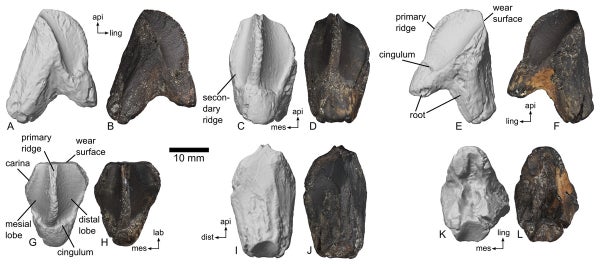
The isolated fossil, washed out of its resting place of over 66 million years by a modern stream, was spotted by paleontologist George Phillips as he searched Mississippi’s Owl Creek Formation for fossils. The tooth was obviously from some sort of herbivorous Cretaceous dinosaur, but what kind? And so, at the intersection of the ancient and modern, Phillips posted a photo of the find to Facebook.
It didn’t take long for preliminary identifications to start popping up. Colleague Lynn Harrell suggested that the tooth belonged to a ceratopsian dinosaur – think Triceratops and its relatives – and shared the post. And that’s what brought the photo to the attention of Harnell’s mutual friend and ceratopsian expert Andrew Farke. “When I saw the picture there was no doubt what it was!,” Farke recalls. The teeth of horned dinosaurs are distinctive and easy to spot. But here’s the rub – no one had expected to find a horned dinosaur here.
On supporting science journalism
If you're enjoying this article, consider supporting our award-winning journalism by subscribing. By purchasing a subscription you are helping to ensure the future of impactful stories about the discoveries and ideas shaping our world today.
“I got in touch with George nearly immediately,” Farke says, “asking about the fossil and if anyone was studying it.” That’s what kicked off a collaboration that alters the picture of Late Cretaceous North America, and hints at other fossils as-yet-undiscovered.
Up until Phillips’ discovery, no one had ever found a definitive horned dinosaur fossil from the Late Cretaceous rock of the eastern United States. Tyrannosaurs, hadrosaurs, ankylosaurs, ostrich mimic dinosaurs and more have turned up, but no horned dinosaurs. The boundary of a vanished sea was the standard explanation.
During the Late Cretaceous, the Western Interior Seaway divided North America into two subcontinents – Laramidia to the west and Appalachia to the east. Apparently various dinosaurs had spread across North America prior to that division, and, given their absence to the east, it seemed the large horned dinosaurs called ceratopsids stayed to the west. “We had basically assumed that they just didn’t make it over,” Farke says, “and probably hadn’t even evolved as a group before Appalachia was isolated from the rest of North America.”
The tooth changes all that. It’s the first evidence that ceratopsids made it east, after all. And even though it doesn’t seem like much, it would be hard to find a better ceratopsid sign. “In terms of identification,” Farke says, “the tooth is about the best possible piece to find short of a complete skull.” The fact that the tooth’s root is split at the bottom, for example, shows that it once sat in the mouth of a large, quadrupedal horned dinosaur akin to Triceratops.
But how did the dinosaur get to Appalachia? That, Farke and Phillips propose, was a matter of timing.

How horned dinosaurs traveled east. Credit: Farke and Phillips 2017
By the very close of the Cretaceous, the Western Interior Seaway was receding off North America. The landmass was opening up, allowing dinosaurs to travel and intermingle in ways they hadn't for millions of years. Given the timing of when big horned dinosaurs evolved and the occurrence of the tooth, then, the most likely scenario is that some of the last horned dinosaurs were spreading eastward as the seaway drained off the continent, spreading through prehistoric Texas, Oklahoma, and Arkansas to make their way down to the Mississippi Embayment. Perhaps additional clues to the march of these dinosaurs are hidden in the strata of these states.
“It’s really exciting to have solid evidence that the Western Interior Seaway had retreated at the end of the Cretaceous to the point where ceratopsids could get from western North America to eastern North America,” Farke says. It really is a lucky find. Exposed, accessible Late Cretaceous strata are rare in the east, and most dinosaurs are known from only bits and pieces. To find a single tooth that changes the great ceratopsid story is luckier than finding a needle in a haystack.
Reference:
Farke, A., Phillips, G. 2017. The first reported ceratopsid dinosaur from eastern North America (Owl Creek Formation, Upper Cretaceous, Mississippi, USA). PeerJ. doi: 10.7717/peerj.3342
