
This article was published in Scientific American’s former blog network and reflects the views of the author, not necessarily those of Scientific American
The scientific field that we now call astrobiology (after some earlier labels fell by the wayside) is a tricky one to characterize. It's definitely interdisciplinary in nature, but you could also call it multidisciplinary, or cross-disciplinary - all terms with distinctions that might not mean very much to most of us, or a lot to some of us.
Astrobiology is also tough to explain because it simultaneously represents a set of ancient questions and very forward-looking questions on the fundamental nature of life and life's environments.
This quality also creates some challenges in figuring out the best way to encourage scientists to talk to each other, to learn from other fields, and to be bold in seeking new ways to tackle their biggest questions. Earlier this year myself and a couple of colleagues published a commentary in Nature ('Exoplanet Science 2.0') to help articulate where we saw things being currently at, and where they might go in this scientific enterprise.
On supporting science journalism
If you're enjoying this article, consider supporting our award-winning journalism by subscribing. By purchasing a subscription you are helping to ensure the future of impactful stories about the discoveries and ideas shaping our world today.
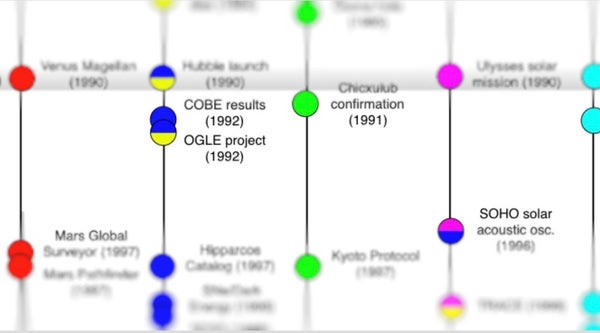
But before that I had hunkered down in the summer of 2017 to hash out a much more detailed lay of the land. To help me get my head around things I put together an infographic (below) charting some of the most relevant and major milestones in scientific fields that have some overlap or synergy with the grander goals of astrobiology.
I thought I'd now share that. It is not meant to be exhaustive in any way. Indeed, this collection may be quite idiosyncratic. The vertical timeline starts with the Viking missions to Mars in 1976 and ticks off various points in the fields of planetary science, astrophysics, Earth and geosciences, heliophysics, biological sciences, and exoplanetary sciences (a field that kicks in around 1992). I'd argue that all of these fields support astrobiology, and in turn can find research questions and directions from the quest to understand the nature of life in the universe.
Splayed across the lines is a curve that approximates the cumulative number of exoplanets discovered year by year.
What do we learn from this? Well, probably all kinds of things. The start of the 1990s was an interesting time. We were busy radar-mapping the surface of Venus, the Hubble telescope was launched, the Human Genome project was getting going, and we were confirming the location and nature of the asteroid impact that played a role in the extinction of non-avian dinosaurs 65 million years ago. A mere 10 years later we'd gotten the first clutch of exoplanets, and had baby steps with a rover on Mars.
Now, in the 2010's we're seeing a renaissance in solar system exploration, from the Kuiper Belt to asteroids and comets (the chart doesn't even include Rosetta or ongoing missions like Hayabusa 2 or Osiris-Rex) at the same time that our catalog of other worlds around other stars is ballooning - and about to balloon more thanks to the TESS mission.
I leave it to the reader to peruse this more, but the bottom line is that if astrobiology really represents a gathering of these fields - a synthesis and expansion of their individual goals - then it's doing awfully well.
.jpeg?w=1350)
Timelines of milestones in different fields that nonetheless inform and relate to astrobiology. Colors represent fields - bi-colored symbols indicate milestones where there is a direct, or likely, relationship to other fields. Credit: C. Scharf 2017