
This article was published in Scientific American’s former blog network and reflects the views of the author, not necessarily those of Scientific American
Dark Energy doesn't seem to dampen star formation
If we live in one part of a multiverse it's possible that other universes have a lot more space-expanding dark energy in them, potentially altering the likelihood of recognizably 'life-bearing' environments. But a round of computer cosmic simulations reported by Salcido et al. suggests that the impact of even a hundred times more dark energy is minimal - stars and planets would likely still be able to form. So why do we live in a universe with so little dark energy?
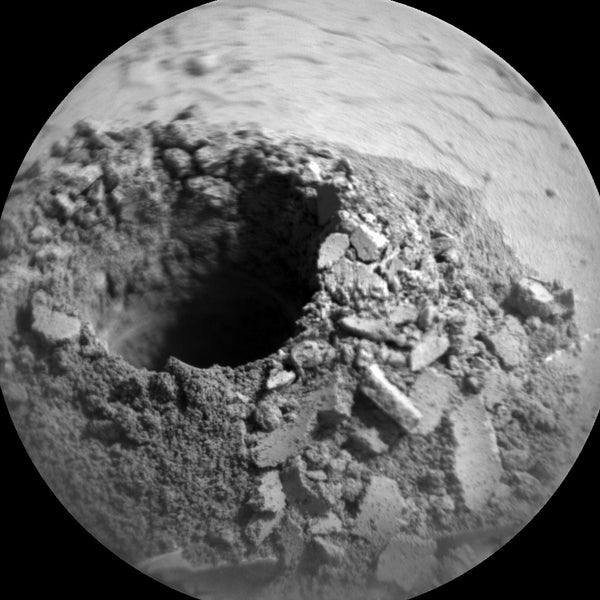
Drill baby, drill on Mars!
On supporting science journalism
If you're enjoying this article, consider supporting our award-winning journalism by subscribing. By purchasing a subscription you are helping to ensure the future of impactful stories about the discoveries and ideas shaping our world today.
For the past 18 months NASA's Curiosity rover's rock drill hasn't been working properly - unable to extend stabilizing posts around the drill itself. Now a workaround has been tested (after earlier tweaks this year) and drilling to a useful depth can resume with the drill pushed into surfaces using the robotic arm itself. Getting samples into the rover's chemical analysis (ChemIn) is still tricky, involving a direct drop-off from the drill bit, but it's looking promising.
Europa's geysers?
Detective work on old magnetic field and plasma data from the Galileo mission to Jupiter (1995-2003 in Jovian system) provides support for the existence of active geyser-like eruptions from the icy moon Europa. During a flyby of Europa at an altitude of about 400 km both the magnetic field external to the spacecraft changed significantly, and the plasma density. These shifts are consistent with earlier claims of erupting plumes, including data from the Hubble Space Telescope. But even if Europa is active, it's not clear whether the erupting material (presumably water-rich) is coming from the moon's internal ocean or structures much closer to the surface.
An alien asteroid?
The asteroid (514107) 2015 BZ509 - a 3 kilometer-sized chunk of material - orbits the Sun at about the distance of Jupiter, but it travels in a retrograde path, the opposite sense to all the planets (you can also think of it as having an orbit completely 'tipped' over). Explaining this is a challenge. A new work by Namouni and Morais studies the stability of this orbit and suggests that it is both very old, and that it was captured from interstellar space - an interloper that just got in the way of the solar system. It's an intriguing possibility, but we still have a poor understanding of the early dynamics of our solar system, so there could also be a more 'in house' explanation.